CiteGraph
Share
CiteGraph
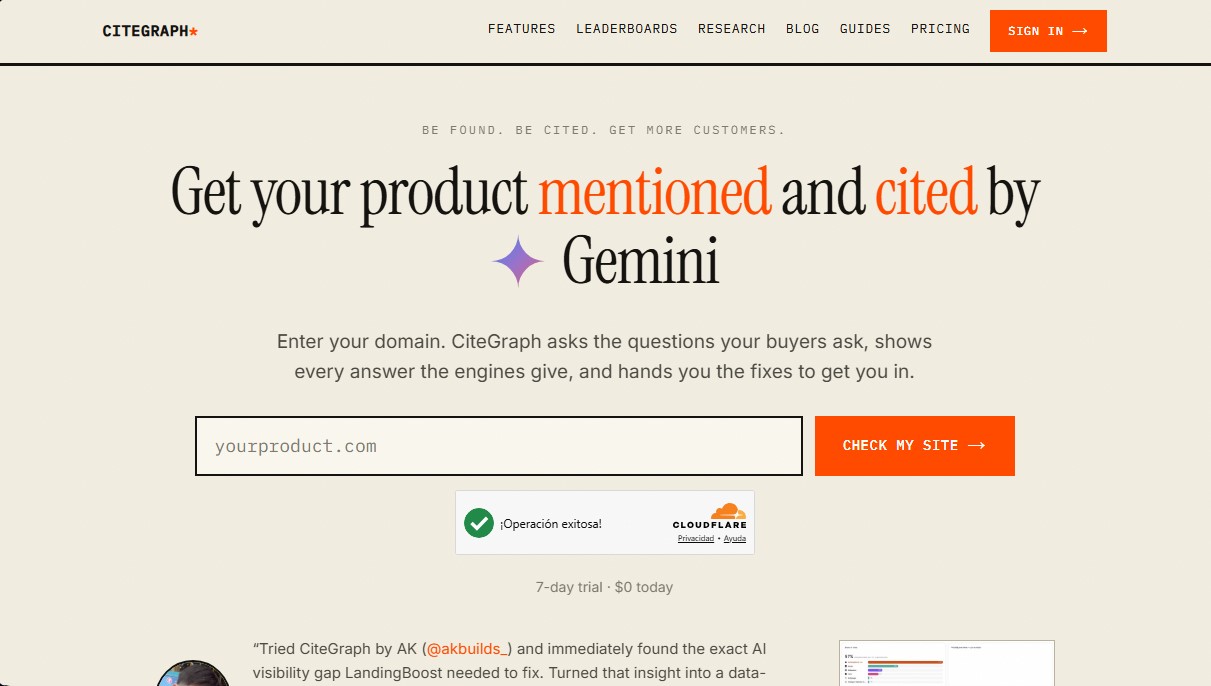
Analyze and improve your product's visibility in AI search engines. Identify why you're missing from answers and get solutions to boost mentions and citations.
General Information about CiteGraph
CiteGraph is a specialized platform for Answer Engine Optimization (AEO) designed to monitor and improve the visibility of products and services within AI-generated responses. Unlike traditional SEO based on "blue links," this tool focuses on getting AI assistants like ChatGPT, Claude, Gemini, and Perplexity to directly mention and cite a brand. It is a solution tailored for founders, marketing teams, and SEO specialists looking to capture traffic from new conversational search interfaces.
CiteGraph’s operation is based on analyzing the actual questions buyers ask assistants, going far beyond simple keywords. Its technology uses official grounded-search APIs to perform repeated scans and obtain statistically significant data. The system does not rely on a single result; instead, it runs multiple executions for each query to mitigate the variability of AI responses, providing clear margins of error in its metrics to ensure the data is actionable from a computer or any management device.
Its core capabilities include:
- Blind spot identification: Locates the exact questions where competitors are mentioned but your brand is missing, providing the literal response given by the engine.
- Cited source mapping: Analyzes which external domains—such as Reddit threads, G2 comparisons, or specialized blogs—are feeding the AI's responses.
- Share of Voice (SoV): Measures the share of mentions against specific rivals, allowing you to track who dominates the answers in each category.
- "The missing phrase" generation: Proposes the specific claim or data point missing from your website so that AI engines can process it and include you in their recommendations.
- MCP Server: A technical integration that allows AI agents and development tools like VS Code or Cursor to access visibility data to apply corrections directly in the code.
The practical utility of CiteGraph lies in its focus on the actual citation rate. The tool delivers an action plan that includes writing pages optimized for processing by large language models and identifying critical third-party sites where a presence is essential. By monitoring which sources the AI consults before recommending a product, companies can stop optimizing blindly and focus on the content that truly builds authority within the AI ecosystem. Additionally, it allows for weekly tracking to validate whether content changes have successfully prompted AI assistants to start citing the user's website.
Features and Use Cases of CiteGraph
How CiteGraph Works
Frequently Asked Questions about CiteGraph
What is CiteGraph and how can it help my business?
CiteGraph is an AI search engine visibility tool that tracks when assistants like ChatGPT or Perplexity mention and cite your product to help you attract more customers.
How is CiteGraph different from traditional SEO?
Unlike SEO, which optimizes for a list of blue links, this tool optimizes direct AI responses by analyzing the sources these engines use to generate their recommendations.
Which AI engines does CiteGraph currently analyze?
The platform provides detailed tracking across four of the market's leading engines—ChatGPT, Claude, Gemini, and Perplexity—using their official APIs.
What exactly are "blind spots" in a report?
Blind spots are the actual buyer questions that AI is answering without mentioning you, showing you exactly which competitors are appearing instead and for what reasons.
Does CiteGraph offer a guarantee if I don't show up in the answers?
There is a 120-day money-back guarantee that refunds your subscription fee if, after following the action plan and publishing the suggested content, you are not mentioned by any engine.
Do I need to install any code on my website?
It isn't required for basic scans, though you can install a tracker on your site to verify which requests AI assistants make when accessing your content.
How much do CiteGraph plans cost?
Plans start at $29 per month for weekly tracking of two domains, with a single-scan option available for $12 without a subscription.
How does the tool help improve my mention rate?
CiteGraph identifies the exact phrasing missing from your content or third-party sites and drafts the necessary information so that engines view you as a reliable and relevant source.
CiteGraph Pricing
Free Version
Get a site readiness score and see a live AI response for the entered domain. Includes access to basic tools:
- AI Visibility Checker to check visibility.
- AI Readiness Check to evaluate site readiness.
- Access to public Leaderboards.
One-Time Payment (No subscription)
Price: 12 $ (first purchase includes 2 scans).
- Run 10 buyer questions 3 times across 4 AI engines.
- Access to verbatim responses, mentioned competitor analysis, and cited sources.
- 15 site checks with optimization suggestions.
- Second scan included to verify improvements.
Starter
Price: 29 $/month (includes 7-day free trial).
- 2 projects (domains).
- 10 buyer questions per project (3 runs per question).
- Weekly tracking across 4 AI engines.
- 30 written pages per month to capture missed questions.
- Share of Voice analysis for 6 competitors.
- Access to "Ask" (scan assistant), MCP server, and Claude.ai connectors.
- CSV data export.
- 1 user (seat).
- 120-day money-back guarantee if no mentions are achieved.
Growth
Price: 69 $/month.
- 3 projects (domains).
- 10 buyer questions per project (5 runs per question).
- Weekly tracking across 4 AI engines.
- 60 written pages per month to capture missed questions.
- Share of Voice analysis for 10 competitors.
- Breakdown by AI engine and historical data.
- Content briefs for writers and priority scan queue.
- 5 users (seats).
- 120-day money-back guarantee if no mentions are achieved.
Scale
Price: 149 $/month.
- 6 projects (domains).
- 10 buyer questions per project (5 runs per question).
- Weekly tracking with top priority.
- 200 written pages per month to capture missed questions.
- Share of Voice analysis for 10 competitors.
- Public dossier link with white-label option.
- Unlimited users.
- 120-day money-back guarantee if no mentions are achieved.
CiteGraph Screenshots