
Share
AI-powered academic search engine analyzing millions of scientific papers. Synthesizes evidence-based answers with citations and streamlines literature reviews.
What is Consensus?
Consensus is an AI-powered search engine designed specifically for scientific and academic research. This tool provides access to a database of over 200 million peer-reviewed research papers, making it easier to locate, understand, and synthesize technical literature quickly and reliably. Unlike conventional search engines, Consensus uses advanced language models to extract direct answers based exclusively on published evidence, making it an efficient alternative to traditional systems for the academic and professional sectors.
The platform's operation is based on a multi-stage information retrieval process. First, it employs a hybrid search that combines semantic search—powered by AI embeddings to capture user intent—with traditional keyword search (BM25). After an initial screening, the system re-ranks the results by evaluating research quality through signals such as journal reputation, publication recency, and citation count. Finally, high-precision AI models analyze the most relevant documents to generate a scientific literature synthesis with transparent attribution, ensuring every piece of data includes its original source.
Key capabilities and practical benefits include:
- Deep Search: Automates complex literature reviews, identifying conflicting arguments and exploring citation graphs in just a few minutes.
- Consensus Meter: A visual feature that indicates the level of expert consensus regarding closed research questions.
- Medical Mode: Filters searches to focus exclusively on high-quality sources, such as clinical guidelines and high-impact medical journals.
- Natural Language Filters: Users can define specific criteria, such as sample size or study design type, directly within their query.
This tool is especially useful for college students, researchers, and clinicians who need to streamline their workflows without compromising rigor. By integrating with global databases like Semantic Scholar and OpenAlex, Consensus minimizes the risk of hallucinations; it does not function as a conventional generative chatbot, but rather as a search engine that grounds every answer in real, verifiable scientific papers. It can be used conveniently from a computer to manage extensive literature reviews or resolve clinical questions professionally and securely.
Consensus features and use cases
How to use Consensus
Consensus FAQ
What is Consensus and what is it used for?
Consensus is an AI-powered search engine designed to find and analyze peer-reviewed scientific research papers across various fields of study.
How does Consensus prevent AI hallucinations or fake sources?
The tool only generates answers based on its database of real research; therefore, every claim includes a direct citation that verifies the existence of the scientific article.
What types of documents are included in the Consensus database?
The system searches through more than 200 million scientific documents, including high-impact journal articles, conference papers, and preprints from sources like Semantic Scholar and OpenAlex.
What is the Consensus Meter feature?
It is a visual tool that analyzes scientific evidence to show the level of consensus or disagreement among researchers regarding a specific yes-or-no question.
Can I use Consensus for free?
Yes, there is a free version that allows you to perform basic searches and get summaries for up to ten research papers at no cost.
What are the benefits of the Deep Search feature?
This feature automates literature reviews by creating complex search strategies that analyze up to 50 articles to identify key arguments and terms.
Are there academic discounts for Consensus?
Students and faculty with a valid institutional email address can request discounts of up to 40% on annual or monthly subscription plans.
How does the Medical Mode search work?
This filter limits results to top-tier clinical sources, analyzing thousands of guidelines and articles from leading medical journals to provide reliable answers.
Consensus pricing and plans
Free
0 $/mes
- Basic quick search using article abstracts only.
- Summaries for up to 10 scientific articles.
- Limited access to Pro Search (includes full text and abstracts) with dynamic analysis of up to 20 articles.
- 3 Deep Searches per month for literature reviews of up to 50 articles.
- Limit of 10 article Snapshots per month.
Pro
15 $/mes (or 10 $/mes billed annually at 120 $)
- Includes all Free plan features.
- Unlimited Pro Search with full-text and abstract analysis for up to 20 articles.
- 15 Deep Searches per month for reviews of up to 50 articles.
- Unlimited article Snapshots.
- Up to 40% discounts available for students, faculty, and clinical staff.
Deep
65 $/mes (or 45 $/mes billed annually at 540 $)
- Includes all Pro plan features.
- Unlimited Pro Search.
- 200 Deep Searches per month for literature reviews of up to 50 articles.
- Unlimited article Snapshots.
- Specifically designed for researchers and clinicians conducting frequent literature reviews.
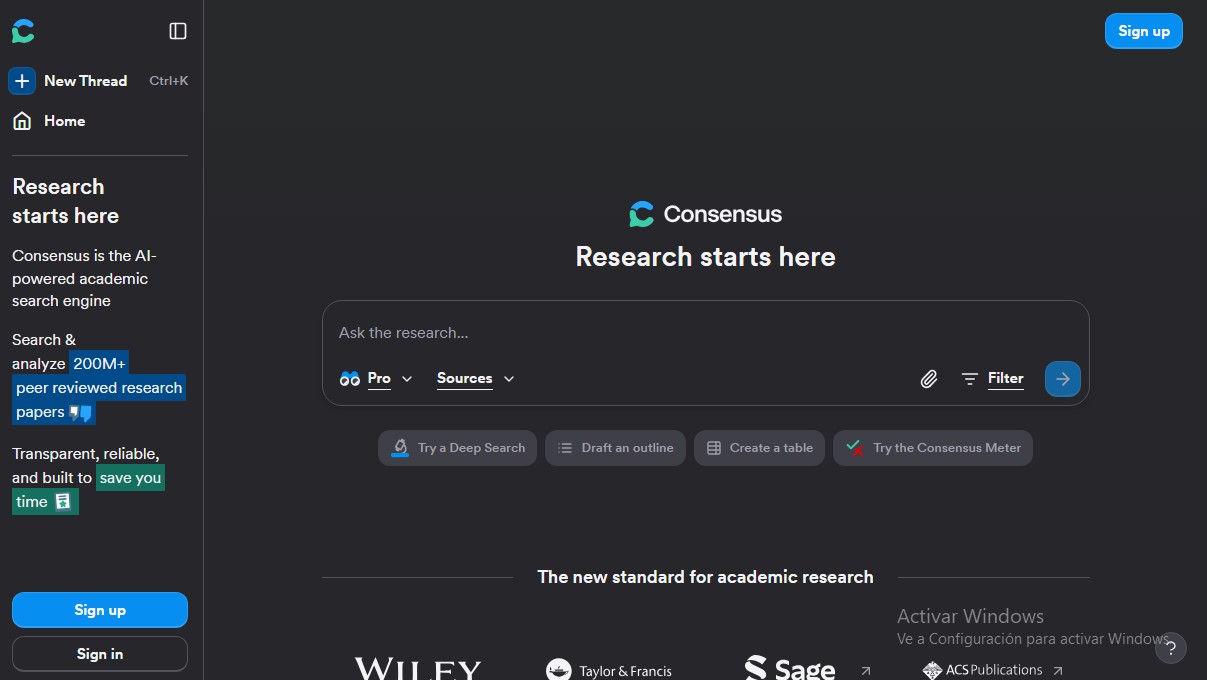
Consensus Screenshots
Consensus alternatives

AutoDock Vina
Automated molecular docking web server. Analyze protein-ligand binding without installing software, featuring affinity reports and 3D pose downloads.



Datalab.to
Convert PDFs and complex documents to Markdown, JSON, or HTML with high precision. Extract data, segment files, and process tables, formulas, and diagrams.