
Share
Create virtual AI employees to automate complex workflows. Optimize customer support, sales, and HR with secure, efficient integrations.
What is Ema?
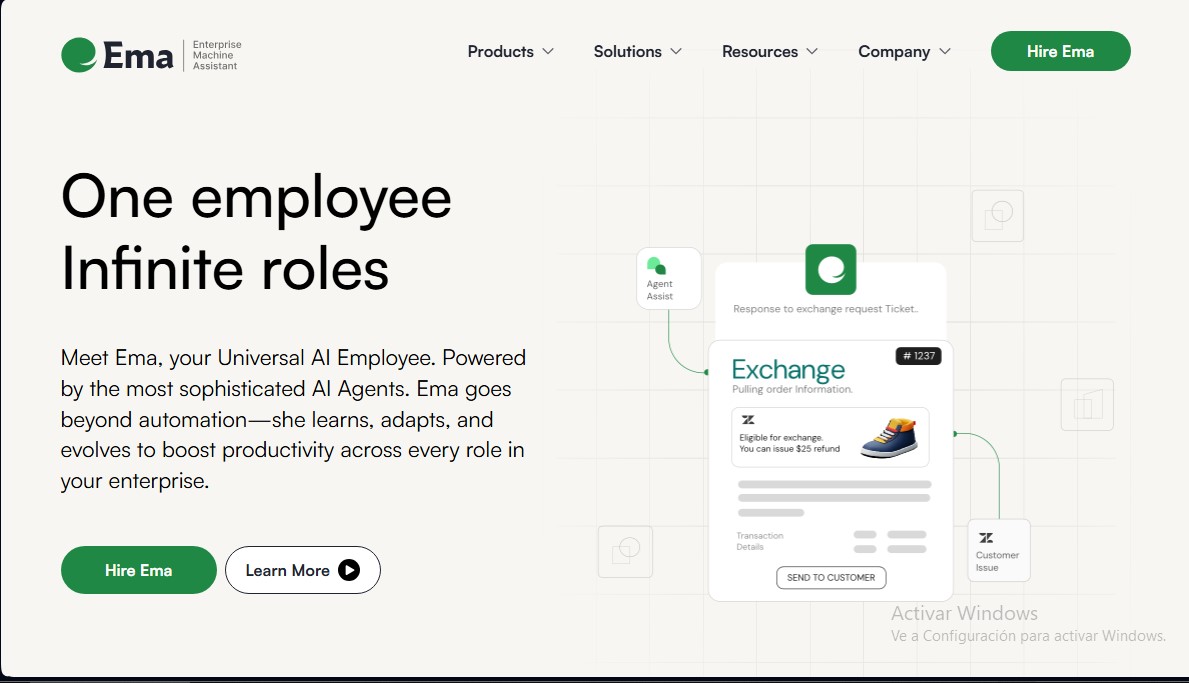
Ema is a generative AI agent platform designed to act as a universal employee within the corporate environment. Unlike traditional automation tools, this solution allows for the creation of AI employees capable of executing complex, end-to-end workflows, adapting to various roles in departments such as sales, customer service, finance, or human resources. Its primary goal is to scale business productivity by delegating operational tasks to autonomous systems that learn and evolve as they interact with the computer and standard corporate tools.
The technology powering Ema is based on EmaFusion™, a proprietary model that combines the outputs of over 100 Large Language Models (LLMs), including public, private, and open-source options. This approach optimizes accuracy and costs by selecting the most suitable mix of models for each specific task based on its complexity. Additionally, its Generative Workflow Engine™ facilitates the activation of new agents using natural language, transforming simple instructions into production-grade autonomous workflows without the need for coding.
The advanced autonomy of these agents allows them to interpret user intent, collaborate with humans, and handle exceptions in real time. Ema integrates natively with hundreds of enterprise applications (CRM, ERP, support tools), enabling a single agent to, for example, screen resumes in an ATS, send interview requests via Slack, and update statuses in management dashboards simultaneously. It doesn't just execute isolated tasks; it takes responsibility for complete business outcomes.
A key differentiator for corporate trust is the inclusion of Human-in-the-Loop (HITL) checkpoints. This allows for the configuration of confidence thresholds so the AI can pause execution and escalate sensitive or ambiguous decisions to a human supervisor, ensuring that business process automation does not compromise reliability. Regarding security, the tool stands out for its data governance, redacting personally identifiable information (PII) before processing it and complying with international standards such as SOC 2, HIPAA, and ISO:42001.
Key features and practical benefits include:
- No-code agent creation: An intuitive visual interface that allows operations or HR teams to set up agents in minutes.
- Continuous contextual learning: Agents consume data from multiple internal sources to improve their operational accuracy with every execution.
- Operational scalability: Instantly multiply the digital workforce to handle spikes in support or sales volume.
- Agnostic and future-proof architecture: By not relying on a single LLM provider, the system constantly integrates the most efficient models on the market.
- Flexible deployment: Agents can operate via chat, embedded applications, or directly integrated into the company’s products.
Ema features and use cases
How to use Ema
Ema FAQ
What exactly is Ema, and what can she do for my business?
Ema is a universal AI employee designed to automate complex workflows and boost productivity across any department in your organization.
How many different roles can Ema play within an organization?
Ema can take on an unlimited number of roles, as she is capable of learning and adapting to customer service, HR, sales, or marketing functions simultaneously.
Do I need coding skills to set up Ema?
No, Ema features a visual no-code interface that allows any business user to build workflows using natural language.
How does Ema protect my company’s sensitive information?
Ema utilizes a governance system that redacts sensitive data before sending it to public models and complies with security standards such as SOC 2 and ISO.
What technology makes Ema more accurate than other tools?
The platform uses a proprietary model called EmaFusion, which intelligently combines over a hundred different language models to optimize for both accuracy and cost.
Can I oversee Ema’s actions before they are finalized?
Yes. You can set up configurable checkpoints so Ema requests a human review for critical decisions or when tasks exceed certain confidence thresholds.
Does Ema integrate with the applications we currently use?
Ema comes pre-integrated with hundreds of enterprise applications, including CRM, ERP, and messaging platforms, ensuring a quick and easy deployment.
How does Ema’s pricing model work?
The pricing model is based on outcomes and delivered value rather than charging per user or per seat, allowing it to scale with the specific needs of each company.
Ema pricing and plans
Custom Plan (Outcome-based)
Pricing: Visit the official website for a custom quote.
- Value-based pricing model focused on delivered outcomes, eliminating per-seat or per-user fees.
- Access to EmaFusion™, which combines 100+ large language models (LLMs) to optimize accuracy and costs.
- AI Employee Builder: No-code interface to create and deploy AI employees in minutes.
- Generative Workflow Engine™ to execute complex end-to-end workflows.
- 200+ pre-built connectors for enterprise applications (CRM, ERP, Slack, etc.).
- Human-in-the-loop (HITL) checkpoints for human oversight on critical decisions.
- Enterprise-grade security with sensitive data (PII) protection and high-level encryption.
- Compliance with international standards (SOC 2, HIPAA, ISO:42001).
- Flexible deployment options: SaaS, private instance, hybrid cloud, or on-premises.
Ema Screenshots
Ema alternatives



Perspective Funnels
Build and manage AI-powered, mobile-optimized sales funnels and landing pages. Capture leads, sell online, or recruit talent—no coding or design skills required.
FactorialHR
AI platform centralizing HR, finance, and IT. Automate payroll, time tracking, and expenses to streamline management and boost your company's productivity.