

LibreChat
Share
Unified open-source interface for managing multiple AI models. Centralize conversations, use agents, and execute code with total control and privacy.
What is LibreChat?
LibreChat is an open-source AI platform designed to centralize access to multiple language models within a single unified and customizable interface. This tool functions as an operational hub that allows users to interact with various providers such as OpenAI, Anthropic, Google, Azure, and AWS Bedrock from one place. As a self-hosted solution, it can be deployed on a local computer or private servers, ensuring that data control and privacy remain under the direct management of the user or company, thereby avoiding vendor lock-in.
The architecture of LibreChat stands out for its extensibility and use of modern technologies like the Model Context Protocol (MCP), which facilitates connections with external tools and services. The platform includes a Code Interpreter capable of executing code in multiple languages securely and without complex configurations. Additionally, its persistent memory system ensures that conversation context is maintained across different sessions, optimizing the relevance of the responses.
Key features of this tool include:
- Advanced Agents: Capable of managing files, interpreting code, and executing actions via APIs to automate complex tasks.
- Artifacts: Enables the creation and visualization of code snippets in React, HTML, and Mermaid diagrams directly within the chat interface.
- Integrated Web Search: Provides real-time internet access to any model, utilizing search and re-ranking systems to enhance accuracy.
- Enterprise Security: Features SSO authentication via OAuth, SAML, and LDAP, as well as moderation tools and two-factor authentication (2FA) systems.
- Advanced Search: The ability to instantly locate messages, files, and code snippets within the history.
This AI tool for teams and developers is ideal for organizations that require a robust and scalable infrastructure. Thanks to its MIT license, the software can be freely modified and distributed, which is highly beneficial for tailoring workflows to specific technical needs. LibreChat supports the use of plugins and custom endpoints, allowing both individual users and large corporations to maintain a sovereign, private, and highly productive AI ecosystem without relying on mandatory external subscriptions. The interface is available in over 30 languages, facilitating its adoption in international work environments.
LibreChat features and use cases
How to use LibreChat
LibreChat FAQ
What is LibreChat and what is it used for?
LibreChat is an open-source AI platform that brings multiple language models together into a single, unified, and customizable interface.
Do I need a paid subscription to use LibreChat?
No, the tool is completely free and open-source under the MIT license, allowing you to use and modify it without any restrictions or monthly fees.
Which AI models can I integrate into the platform?
You can connect services from leading providers such as OpenAI, Anthropic, Google, Azure, AWS Bedrock, and many other external systems.
Can I install LibreChat on my own servers?
Yes, the application is designed to be self-hosted, ensuring you maintain full control over your infrastructure and data privacy.
Does LibreChat offer security features for enterprise environments?
Yes, it includes advanced options such as two-factor authentication (2FA) and Single Sign-On (SSO) systems using OAuth, SAML, and LDAP protocols.
What do agents do within the tool?
Agents allow you to manage files, interpret code, and perform advanced actions through various APIs.
What are LibreChat Artifacts?
They are visual components that allow you to create and preview React or HTML code, as well as generate Mermaid diagrams directly within the chat window.
Does the tool have web search capabilities?
Yes, it features an integrated web search function that allows any model to access the internet in real time for up-to-date results.
How does conversation memory work in LibreChat?
The platform maintains persistent context throughout conversations, allowing the AI to remember previous interactions with the user.
Can LibreChat be used in different languages?
Yes, the user interface is available in over thirty languages, thanks to translations provided by the developer community.
LibreChat pricing and plans
Open Source Version: 0 $ (Free)
MIT-licensed open-source platform with no subscriptions or usage restrictions.
Unified interface compatible with multiple AI providers (OpenAI, Anthropic, Google, Azure, AWS Bedrock, and others).
Self-hosted on your own infrastructure for total control over privacy and data.
Advanced agents with file management, code interpretation, and API-driven action execution.
Support for Artifacts to create React code, HTML, and Mermaid diagrams directly in the chat.
Web search integration with real-time internet access and persistent memory across conversations.
Model Context Protocol (MCP) support to connect with any tool or service.
Enterprise-grade features including SSO (OAuth, SAML, LDAP), two-factor authentication, and moderation tools.
Multilingual interface available in over 30 languages.
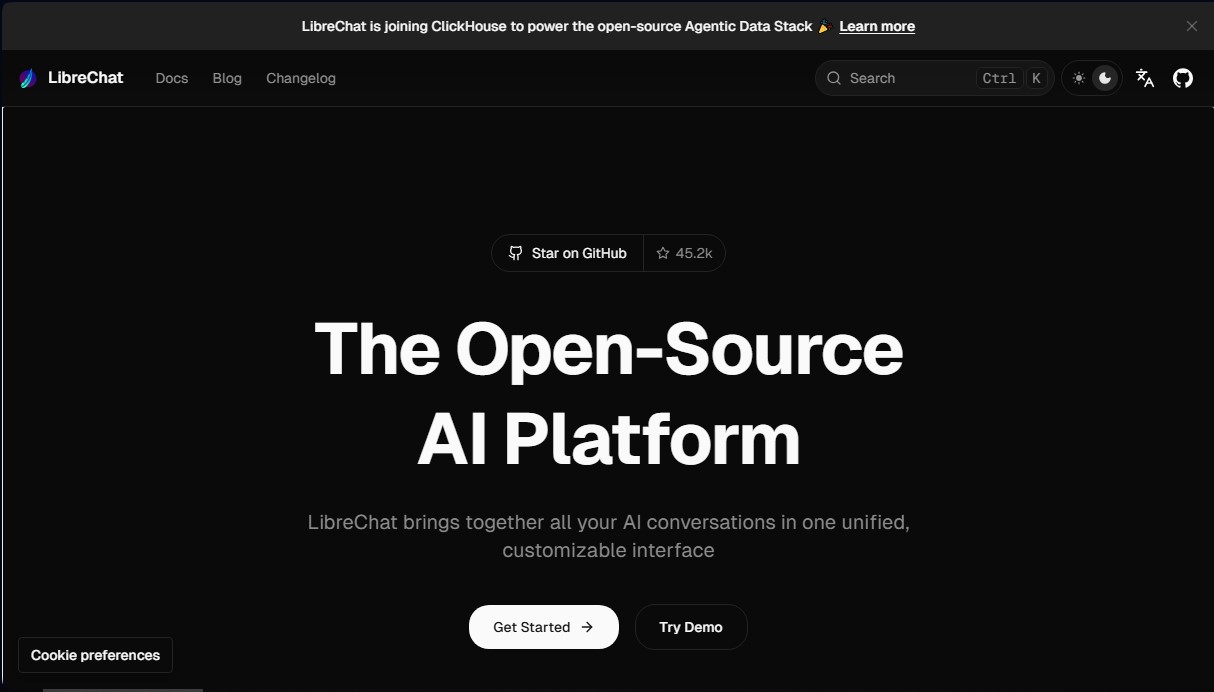
LibreChat Screenshots
LibreChat alternatives
rabbit OS3
Agentic OS that automates tasks and manages files, connecting your computers with AI models to run workflows using natural language.

Agentkit: AI Automations
Automate customer support on Instagram, WhatsApp, and the web with AI agents trained on your content to answer questions and capture leads 24/7.


BridgeForge
Build bridge pages and use voice-cloned AI assistants to close sales after signup. Handle objections in real-time and automate phone and text follow-ups.

ProductBridge
AI platform for support and feedback management. Resolve chats, merge duplicate suggestions, and prioritize the product roadmap based on real customer impact.