Parallel Web Systems
Share
Parallel Web Systems
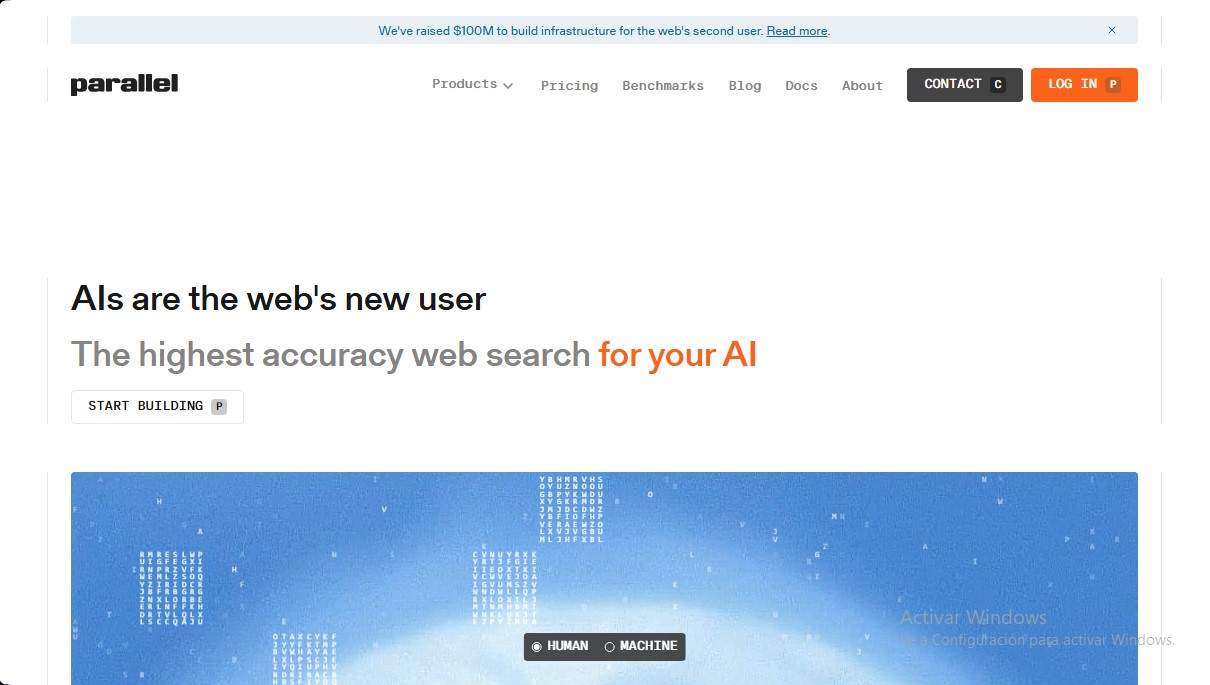
Web search and scraping API for AI agents. Offers accurate data, deep research, and monitoring with verifiable results and per-query pricing.
General Information about Parallel Web Systems
Parallel Web Systems is an advanced infrastructure specifically designed to serve as the technical interface between artificial intelligence and the open web. It is defined as a web search API built so that AI agents, natural language processing systems, and language models can navigate, extract, and process internet information with higher precision than conventional search engines. Unlike tools designed for human consumption, this platform optimizes data retrieval to power automated workflows and deep research assistants.
Parallel’s technology is based on a high-fidelity search approach that minimizes model hallucinations through cross-data verification. Its architecture utilizes an evidence-based output system where every piece of data delivered features traceability and verifiable provenance. This allows developers to adjust the computing budget based on the complexity of the task, facilitating everything from quick queries to multi-hop reasoning processes to solve complex questions that require cross-referencing multiple sources.
The platform deploys its functional capabilities through various specialized APIs:
- Task API: Executes deep research with structured results, optimized for quality and data freshness in automations.
- Search API: Provides ranked URLs and compressed text snippets with high semantic density, ideal for AI agent context.
- Extract API: Enables the extraction of clean, relevant content from any webpage, removing unnecessary noise from the source code.
- Monitor API: Performs continuous tracking of changes or specific web events, programmatically notifying of updates.
- Find All API: Generates structured datasets from criteria defined in natural language, identifying entities that match specific requirements.
The primary benefit of Parallel Web Systems is its ability to provide real-time web context with precision validated against demanding benchmarks, surpassing the standard search capabilities of other models. It is a robust solution for companies requiring custom data enrichment and the creation of large-scale datasets directly from the browser. With SOC-2 Type 2 certification, it guarantees the security standards necessary for enterprise applications in sectors where information reliability is critical, such as legal or finance.
The tool integrates natively with modern development environments like the Vercel AI SDK, allowing agents to operate autonomously and efficiently from any computer or server. Its design is built to scale with predictable costs, as the billing system is based on query complexity rather than token volume, facilitating resource management in generative artificial intelligence projects.
Features and Use Cases of Parallel Web Systems
How Parallel Web Systems Works
Frequently Asked Questions about Parallel Web Systems
What is Parallel Web Systems and what is its primary function?
Parallel is an API infrastructure built specifically for AI to search, extract, and monitor web information with high precision.
How are costs calculated when using Parallel tools?
Unlike other services, costs are based on a flat fee per request rather than the number of tokens consumed, allowing for predictable spending.
Can I try Parallel Web Systems for free?
Yes, the platform allows you to run up to 16,000 requests at no cost, so developers can validate their integrations and workflows.
What level of security does the platform offer for handling corporate data?
The tool is SOC 2 Type II certified, ensuring it meets the strictest security and privacy standards for enterprise environments.
What types of APIs are currently available on Parallel?
We offer specific solutions for web search, content extraction, deep research, web-contextual chat, event monitoring, and dataset creation.
How does Parallel help reduce AI model hallucinations?
The system generates responses based on verifiable evidence and cross-referenced data, providing the exact provenance and sources for all information retrieved from the web.
What advantages does the Parallel Task API offer over a standard web search?
This API allows for complex, asynchronous research, adjusting the compute budget based on the task's difficulty to deliver highly structured results.
Does Parallel Web Systems offer support or integrations for developers?
Yes, we provide a command-line interface (CLI), native integration with the Vercel AI SDK, and dedicated technical support for enterprise-level clients.
Parallel Web Systems Pricing
Free Tier
- Up to 16,000 free requests to get started.
- Up to $250 in free credits for qualifying startups.
Pay-as-you-go (Direct Access APIs)
- Search API: $0.005 per 10 results. Includes ranked URLs and compressed snippets. 600 requests per minute limit.
- Extract API: $0.001 per request. Direct extraction of web page content. 600 requests per minute limit.
- Chat API: $0.005 per request. Fast LLM responses with web research and citations. 300 requests per minute limit.
- Monitor API: $0.003 per request. Track changes and specific events across the web. 300 requests per minute limit.
- Find All API: Between $0.03 and $1 per match. Create structured datasets from queries. 25 requests per hour limit.
Task API (Deep Research)
- Lite: $0.005 per request ($5 per 1k req). Optimized for basic information retrieval.
- Base: $0.01 per request ($10 per 1k req). For simple web research.
- Core / Core 2x: From $0.025 to $0.05 per request. For complex research with snippets and reasoning.
- Pro: $0.10 per request ($100 per 1k req). For exploratory web research with up to 20 output fields.
- Ultra (1x, 2x, 4x, and 8x versions): From $0.30 to $2.40 per request. Advanced deep research with processing times of up to 30 minutes.
- General limit of 2,000 requests per minute for Task API.
Enterprise
- Pricing: Contact us via the official website for a demo and a custom quote.
- Volume-based discounts.
- Custom data retention agreements and DPAs.
- Rate limits tailored to customer needs.
- Dedicated technical support and onboarding.
- Early access to new products and features.
Parallel Web Systems Screenshots