
Share
AI solution for text-to-speech, transcription, cloning, and real-time translation. Offers low-latency models to build professional voice agents.
What is Gradium?
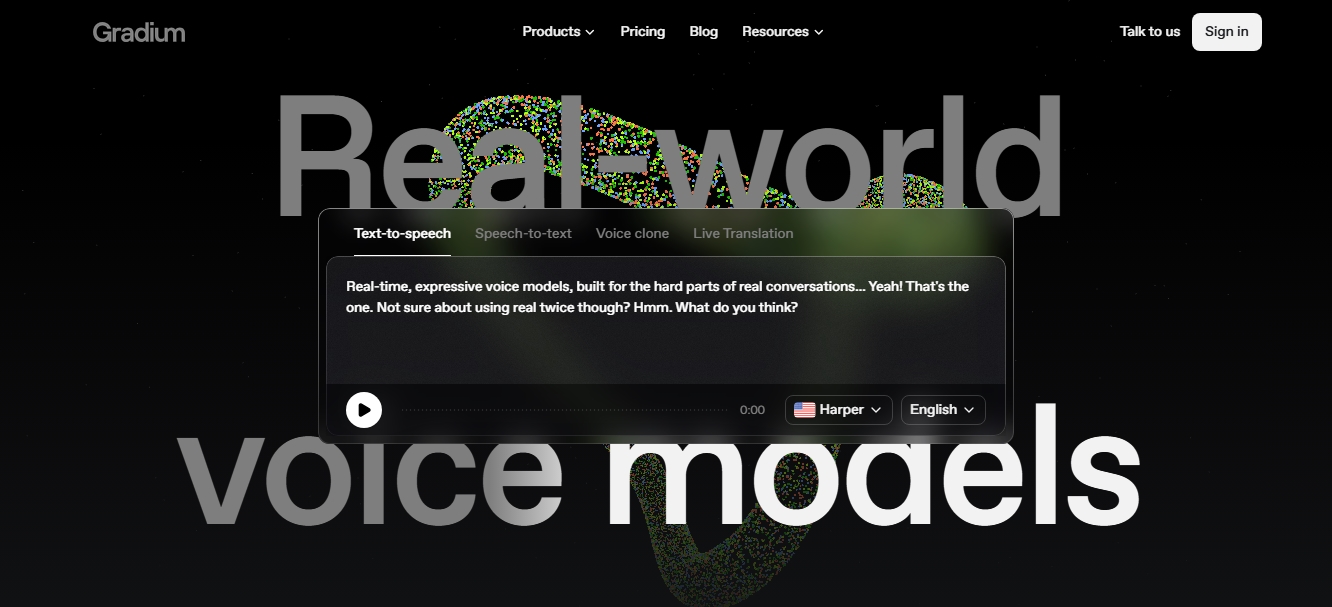
Gradium is an advanced voice AI platform designed to provide comprehensive real-time audio processing solutions. This tool allows developers and businesses to implement text-to-speech (TTS), audio transcription (STT), and voice cloning systems with a specific focus on low latency and natural expressiveness. Its architecture is optimized to handle the technical challenges of real-world conversations, making it a robust choice for building intelligent voice agents and automated customer service systems that require fluid, human-like interaction.
Gradium's text-to-speech engine stands out for its expressive streaming capabilities and the use of custom pronunciation dictionaries. It offers ultra-low latency, delivering the first audio chunk in approximately 200 ms, which is critical for telephony applications and virtual assistants that cannot afford unnatural pauses. Meanwhile, its speech-to-text technology incorporates advanced features such as code-switching (detecting language changes within the same sentence), custom vocabulary, and semantic VAD (Voice Activity Detection) to improve turn-taking management in dialogues. With a Word Error Rate (WER) of just 3.2%, it guarantees superior transcription accuracy.
One of the tool's most powerful capabilities is high-fidelity voice cloning. Gradium allows for the generation of instant clones from just 10 seconds of audio or the design of custom professional voices using descriptive prompts. Additionally, it includes a live translation (Speech-to-Speech) system that preserves the speaker's original prosody and tone while interpreting content in real time. This functionality facilitates multilingual communication without losing the original user's vocal identity.
Regarding its infrastructure and deployment, the tool offers the following technical features:
Bidirectional streaming via WebSocket APIs for synchronous communication.
Flexible deployment including cloud API, dedicated instances, on-premise options for data sovereignty, and on-device execution.
Optimized models with 100 million parameters that run entirely offline on a computer CPU, mobile device, or Raspberry Pi.
Simplified integration through Python and Rust SDKs, compatible with agent frameworks like LiveKit and Pipecat.
Gradium is geared toward engineers and companies that need to scale voice products without sacrificing reliability. Its ability to maintain flat latency even under massive workloads positions it as an enterprise-grade technical infrastructure for developing the next generation of voice interfaces.
Gradium features and use cases
How to use Gradium
Gradium FAQ
What are the primary services offered by the Gradium platform?
Gradium provides an advanced suite of voice models that includes text-to-speech, transcription, voice cloning, and low-latency real-time translation.
Can I try Gradium for free?
Yes, we offer a free plan that includes 45,000 credits to test our tools—no credit card required.
How does the credit system work within the subscription plans?
Usage depends on the specific service; for example, each character in the text-to-speech model equals one credit, while each second of transcription consumes three credits.
What are the requirements for Gradium’s voice cloning feature?
You can create an instant voice clone with just ten seconds of audio or request a professional clone for the highest possible fidelity and naturalness.
Does Gradium offer a solution for using models offline?
We offer models optimized for local execution on CPUs, allowing you to perform text-to-speech conversions privately and completely offline.
What happens if I use up all my credits before the end of the month?
If you run out of credits, you can either wait for your next monthly renewal or upgrade to a higher tier to receive additional credits immediately.
What is the estimated latency for the real-time voice models?
Our infrastructure is built for demanding production environments, offering ultra-low latency that delivers the initial audio output in approximately 200 milliseconds.
What happens to unused credits at the end of my billing cycle?
Credits included in monthly plans are intended for use within the current billing period and do not roll over to the following month.
Gradium pricing and plans
Free
$0/mo
45,000 credits included.
Approximate equivalent: 1 hour of Text-to-Speech (TTS), 4 hours of Speech-to-Text (STT), or 3 hours of STT translation.
Access to real-time voice models and instant voice cloning.
XS
$13/mo
225,000 credits included.
Approximate equivalent: 5 hours of TTS, 21 hours of STT, or 16 hours of STT translation.
Includes all basic API features and support for small-scale applications.
S
$43/mo
900,000 credits included.
Approximate equivalent: 20 hours of TTS, 83 hours of STT, or 63 hours of STT translation.
Designed for growing projects with higher audio processing needs.
M
$340/mo
9,000,000 credits included.
Approximate equivalent: 200 hours of TTS, 833 hours of STT, or 625 hours of STT translation.
Optimized for tools requiring high concurrency and scalability.
L
$1,615/mo
45,000,000 credits included.
Approximate equivalent: 1,000 hours of TTS, 4,167 hours of STT, or 3,125 hours of STT translation.
Plan for enterprises with high traffic volume and a need for stable low latency.
Enterprise
Custom Pricing (Contact Sales)
Unlimited credits.
Direct engineering support.
Early access to new models and research previews.
Deployment options for private cloud, dedicated instances, or on-premise.
Additional information on credit consumption:
Text-to-Speech: 1 credit per character.
Speech-to-Text: 3 credits per second.
Speech-to-Text Translation: 4 credits per second.
Speech-to-Speech Translation: 30 credits per second (currently 50% off as an introductory offer).
Gradium Screenshots
Gradium alternatives
TextInMyVoice
Clone your voice with a short sample to turn text into natural voiceovers. Generate and download MP3s in your own tone for free, no registration required.

SpeakCrate
Open-source API for local, private speech synthesis. Generate multilingual audio on your own servers with OpenAI standard compatibility.
Vidverse AI
Vidverse AI brings several AI video, image and voice models into one web and mobile app, so you can turn text or photos into clips, images and voiceovers.


AI ReFounder
24/7 AI voice agent for online stores. Automatically handle calls, resolve inquiries, and close sales with seamless Shopify integration.