

Share
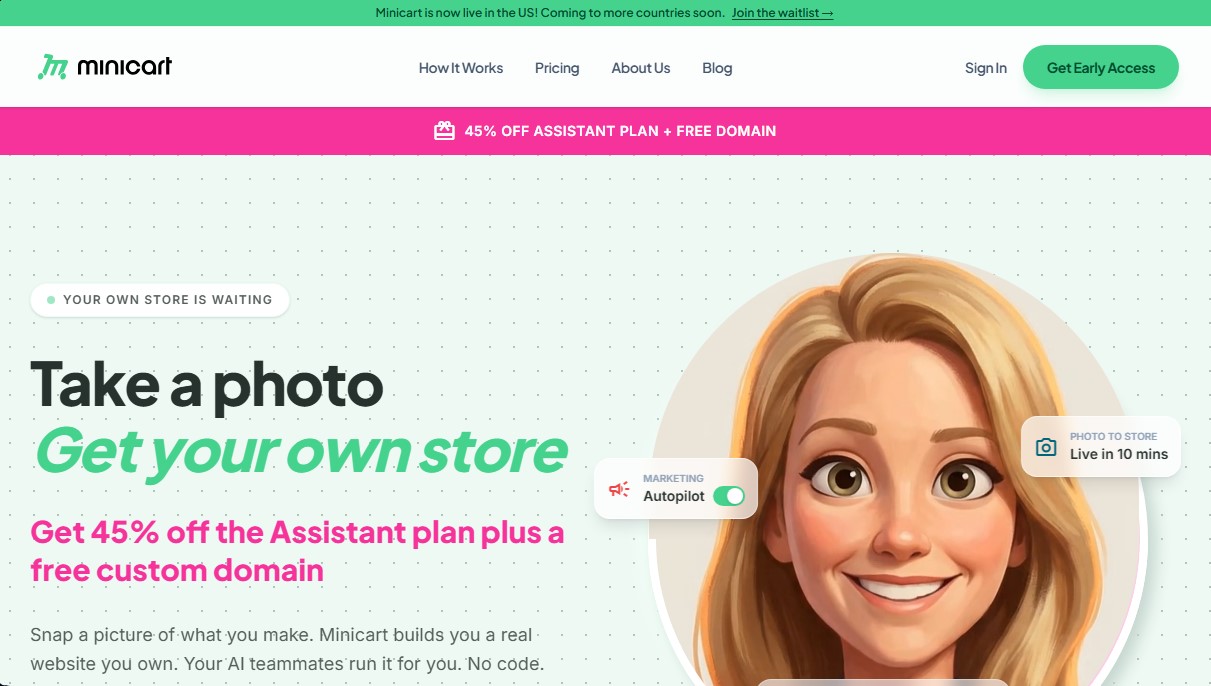
Build a professional online store from a photo. Manage sales, marketing, and logistics with AI. Zero listing fees and no-code required.
What is Minicart?
Minicart is an AI-powered e-commerce platform designed for creators and entrepreneurs to launch their own online stores instantly. Its primary function is to transform a product photo into a functional sales website in less than ten minutes, eliminating the need for technical design or programming skills. Unlike conventional marketplaces, this tool allows users to own their own domain and manage their customer database independently.
Minicart’s operation is based on an AI agent automation system of specialized assistants that act as a 24/7 virtual workforce. These assistants handle the business's most complex operational tasks:
- Sloane (Store Management): Handles site building, payment processing, sales tracking, and keeping product listings up to date.
- Milo (Digital Marketing): Automatically generates drafts for social media platforms like Instagram, creates lifestyle images, and designs discount codes to drive traffic.
- Logan (Logistics and Customer Service): Manages inventory, prepares shipping labels, processes refunds, and drafts customer responses based on previous inquiries, which the user can then review and approve.
Interaction with the tool is done through an intuitive chat interface. Users can manage their inventory or make global changes—such as updating prices for an entire category—simply by sending natural language text commands from their mobile device or computer. Additionally, Minicart includes a one-click import feature to migrate entire catalogs from platforms like Etsy, Shopify, or eBay, automatically extracting titles, descriptions, and photos without affecting the original store.
This solution is especially useful for artisans and small sellers looking for an AI sales tool that simplifies logistics and marketing. By not charging per-product listing fees, it makes scaling large inventories easy. Minicart’s technology optimizes product descriptions and images to provide a professional finish from the very beginning, allowing creators to focus on making their products while the AI manages the daily operations of the online store.
Minicart features and use cases
How to use Minicart
Minicart FAQ
What is Minicart and how does it work to create my online store?
Minicart is an AI-powered tool that creates a sales-ready website from a simple photo of your products in less than ten minutes.
Do I need programming or design skills to use Minicart?
No technical skills are required. If you know how to send a text message or take a photo, you can manage your entire business using chat commands.
Can I import my products from Etsy, Shopify, or eBay to Minicart?
Yes, you can import your entire product catalog, photos, and descriptions with a single click by pasting the link to your current store without any downtime for your existing site.
What tasks do the AI assistants perform in Minicart?
Your virtual assistants—Sloane, Milo, and Logan—handle website updates, write social media posts, manage inventory, and answer customer questions.
Are there fees for listing products on Minicart?
There are no listing fees, so you can upload as many items as you like and only pay a small transaction fee when you make a sale.
Do I own my customer data and my domain with Minicart?
Yes. Unlike other digital marketplaces, you are the absolute owner of your brand, your customer email list, and your own custom domain.
How much does the basic plan cost to start selling?
There is a free plan that includes all the essential features to launch your store and manage payments without needing to enter a credit card to get started.
Can I use my own custom domain on my Minicart store?
Yes, you can connect a domain you already own or purchase a new one to give your brand a professional and independent online presence.
How do I manage orders and shipping through the tool?
Management is handled through a chat interface where your assistant, Logan, prepares shipping labels, tracks packages, and handles any returns.
Is Minicart available to users living outside the United States?
The tool is currently operational in the United States and will be expanding to other countries soon, so you can join the waitlist for early access.
Minicart pricing and plans
Sloane Storefront Plan (Free)
Price: $0/month.
- Online store with unlimited secure hosting.
- Customizable themes and layouts.
- Product, variant, and collection management.
- Store updates via AI chat.
- Payment and bank transfer setup.
- Revenue dashboards and sales tax calculation.
- Limits: Up to 2 users, AI-assisted product images for up to 20 products, 6% + $0.30 transaction fee (online), and a $1 fee for revenue payouts under $50.
Assistant Plan
Price: $10/month ($19 first-year promotion).
- Includes all Free plan features.
- Custom domain (free for a limited time).
- Management of up to 100 products with AI-generated images.
- Limits: Up to 3 users and a reduced transaction fee of 2.9% + $0.30 (online).
Manager Plan
Price: $49/month.
- Includes all Assistant plan features.
- Priority support.
- Management of up to 250 products with AI-generated images.
- Limits: Up to 5 users and a reduced transaction fee of 2.7% + $0.30 (online).
Director Plan
Price: $199/month.
- Includes all Manager plan features.
- Unlimited AI-assisted product images.
- Limits: Up to 15 users and a reduced transaction fee of 2.5% + $0.30 (online).
Milo Marketing Add-on (Assistant)
Price: $39/month.
- Weekly AI-assisted post generation for Instagram and TikTok.
- Creation of ready-to-post carousel images.
- Promotional landing pages for products on sale.
Minicart Screenshots
Minicart alternatives



Agentkit: AI Automations
Automate customer support on Instagram, WhatsApp, and the web with AI agents trained on your content to answer questions and capture leads 24/7.
inboxpilot
AI assistant that sorts emails and drafts automated replies in Gmail and Outlook based on your company’s documents and data.


ProductBridge
AI platform for support and feedback management. Resolve chats, merge duplicate suggestions, and prioritize the product roadmap based on real customer impact.