Optimus by Iacon Autonomics
Share
Autonomous researcher designing experiments and evaluating algorithms to train AI models. Automates improvement cycles for LLMs, robotics, and various complex systems.
What is Optimus by Iacon Autonomics?
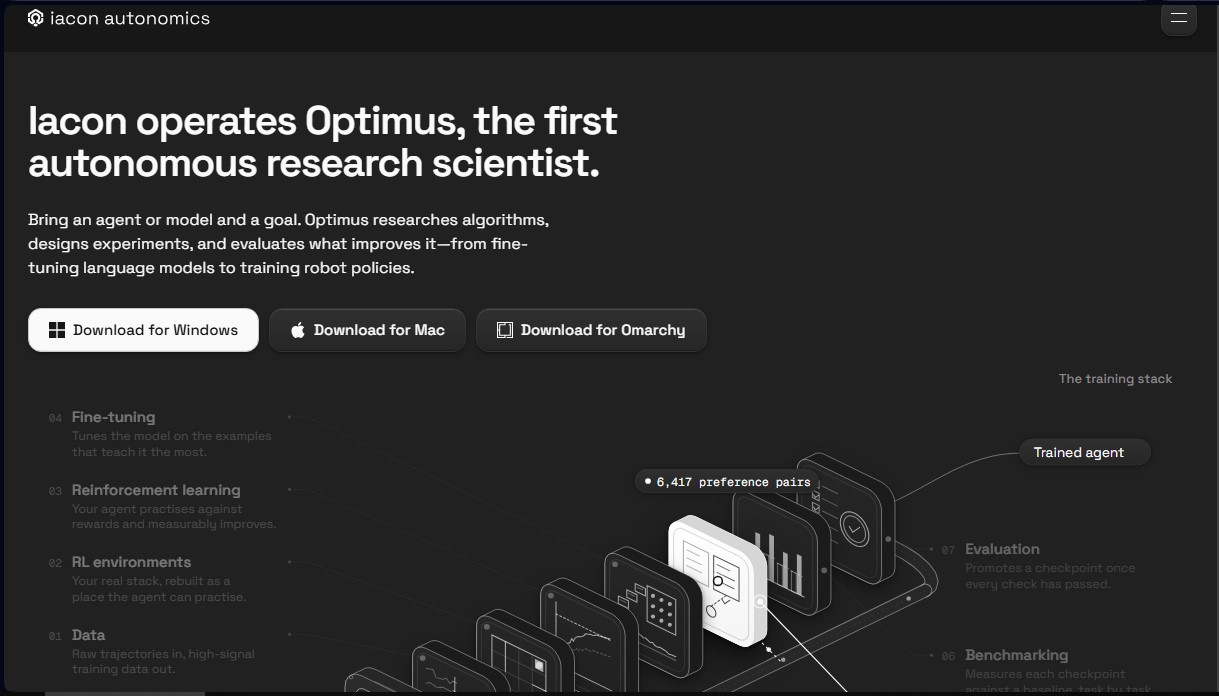
Optimus by Iacon Autonomics is defined as the first autonomous research scientist designed to automate the full development and optimization cycle of artificial intelligence models. This tool allows academic labs, independent researchers, and engineering teams to delegate complex tasks such as algorithm research, scientific experiment design, and result evaluation. Its primary function is to close the training loop through practice, observation, and constant improvement within a controlled environment.
The operation of Optimus is based on a Reinforcement Learning approach at scale. The user sets the project's direction by defining the environments, rewards, and success criteria. From there, the autonomous agent executes scientific experimentation directly on the client's tech stack, implementing state-of-the-art (SOTA) research or synthesizing novel methods to filter high-signal trajectories. This technology is capable of training generalizable policies from raw interactions, which is fundamental for advancing distributed superintelligence in domain-specific models.
The capabilities of Optimus by Iacon Autonomics are versatile and apply to various AI architectures:
- Language Models (LLMs): Optimization and fine-tuning for specific tasks.
- Robotics and Control Policies: Training agents in simulators like MuJoCo for manipulation and movement tasks.
- Diffusion Models and Biological Systems: Application of autonomous research in complex scientific fields.
- Agents and NPCs: Creation and evaluation of behaviors in virtual environments.
- Evaluation Infrastructure: Development of custom testbeds, such as benchmarks to measure the efficacy of research agents.
This system is designed for professionals who need to scale their research organizations without the limitations of constant manual labor. By running natively on the user’s hardware or the arkenOS operating system, it ensures privacy and control over the tools and data used. Companies and leading institutions such as NVIDIA, Google DeepMind, Meta, and Carnegie Mellon University are already using this technology for tasks ranging from teaching language models how to code to developing testbeds for failure detection in autonomous agents.
Optimus stands out for its ability to handle long-horizon tasks and unsolved problems, integrating with compute providers and simulators to turn continuous training loops into proprietary user assets. It is a robust solution for those seeking scientific research automation with unlimited agent concurrency, allowing teams to focus on defining strategic goals while the AI manages technical execution and rigorous experimentation.
Optimus by Iacon Autonomics features and use cases
How to use Optimus by Iacon Autonomics
Optimus by Iacon Autonomics FAQ
What exactly is Optimus from Iacon Autonomics?
It is the first autonomous research scientist designed to independently investigate algorithms, design experiments, and evaluate improvements in language models or robotics policies.
How does Optimus assist in the agent training process?
The tool automates the universal cycle of practice, observation, and improvement within a specific environment, implementing advanced research methods to filter for high-signal trajectories.
In which sectors or fields can Optimus technology be applied?
Its versatility allows it to work with language models, diffusion systems, robotics, non-player characters (NPCs), biological systems, and any user-defined custom policies.
What do the Iacon Autonomics research grants include?
They offer one free year of Arkenos, valued at thirty thousand dollars, along with three months of unlimited access to AI model tokens for academic labs and non-profit organizations.
Where does the platform run, and how is compute managed?
All plans run the workspace natively on the client’s hardware with unlimited agent concurrency and allow users to connect their own provider subscription keys.
What are the primary differences between the Optimus Genesis and Vector plans?
The Genesis plan is geared toward independent researchers with up to three members, while the Vector plan is designed for established teams of up to ten members looking to scale their experiments.
Can I request custom engineering services from Iacon?
Yes, the company offers the ability to build custom infrastructure, such as reinforcement learning environments, or to embed researchers directly into client teams for specific projects.
Optimus by Iacon Autonomics pricing and plans
Research Grants (Free)
One free year of Arkenos (a $30,000 value).
Three months of tokens for unrestricted AI models.
Available to academic labs, non-profits, and independent researchers via application.
Genesis: $200 / user / month
Up to 3 team members.
Unlimited agent concurrency.
Local workspace and native tools.
30-day trial via BYOK (Bring Your Own Key).
Shared compute on paid plans and usage-based billing for tokens from our own provider.
Vector: $2,500 / month
Up to 10 team members.
Unlimited agent concurrency.
Local workspace and native tools.
30-day trial via BYOK (Bring Your Own Key).
Designed for established research teams scaling experiments with shared compute.
Custom Engineering & Research: Contact for pricing
Custom infrastructure, RL environments, simulators, and benchmarks.
Option to embed Iacon researchers directly into the client's team.
Budget and scope are custom-defined before work begins.
Optimus by Iacon Autonomics Screenshots
Optimus by Iacon Autonomics alternatives

Tradebreath
Tradebreath is a backtesting platform with tick-by-tick market replay and an AI agent that writes and tests trading strategies across 800+ symbols.

Confident AI
LLM evaluation platform to test AI workflows, measure quality metrics, and automate testing in the development cycle without relying on engineering.