

Share
What is Replicate?
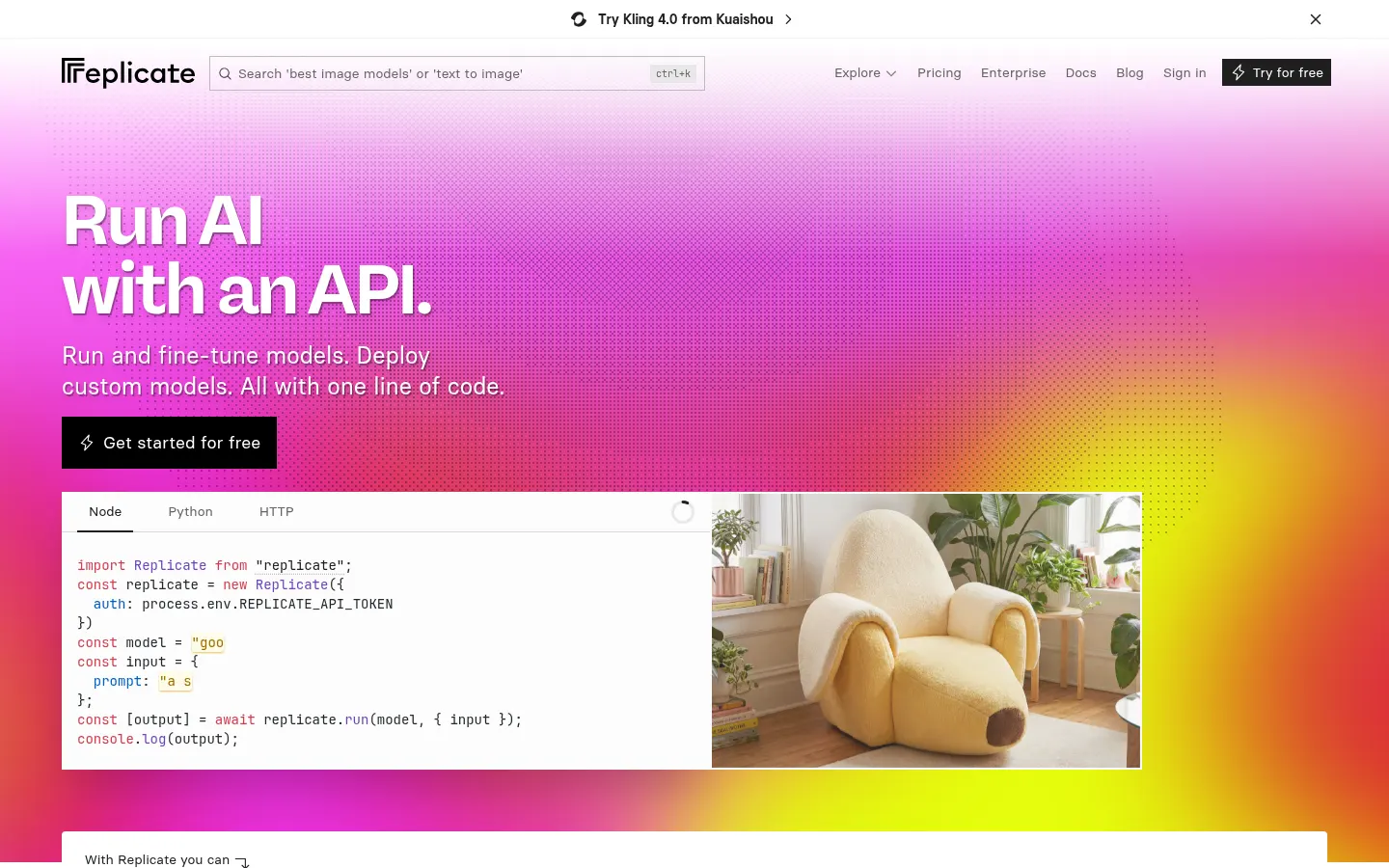
Replicate is a platform to run AI models through an API, with thousands of image, video, audio, music and language models published by companies and its community. Every model has a production-ready API you call with a single line of code.
What is Replicate used for?
It lets you add generative AI to a product without building your own infrastructure. You can call models from labs such as Black Forest Labs, Google, OpenAI, ByteDance or Anthropic, try them in the browser and ship with the same API. When you need something more specific, you can fine-tune models on your data or deploy your own code.
What kinds of models are on Replicate?
- Image generation and reference-based editing.
- Video from text or a starting image.
- Multilingual text-to-speech and music generation.
- Large language models and vision models.
- Thousands of ready-to-use community models.
How does Replicate infrastructure work?
Public models run on shared GPUs and you only use the time it takes to process your request. Private models can run on dedicated hardware, from CPU up to 8x Nvidia H100 or H200 setups, scaling with demand. Fast-booting fine-tunes only consume time while active.
Who is Replicate for?
Developers, startups and product teams adding image, video or voice to their apps, and researchers who want to publish models with a working API instead of a demo. It is handy for rapid prototyping and comparing models before committing to one.
Replicate pros and cons
- Pro: huge catalog of models with production-ready APIs
- Pro: usage based on processing time with no servers to maintain
- Pro: publish and deploy your own models
- Con: spend is hard to forecast at high volume
- Con: rarely used models can be slow to cold-start
Replicate features and use cases
How to use Replicate
Replicate FAQ
What is Replicate?
Replicate is a cloud platform to run, fine-tune and deploy AI models through an API.
How much does Replicate cost?
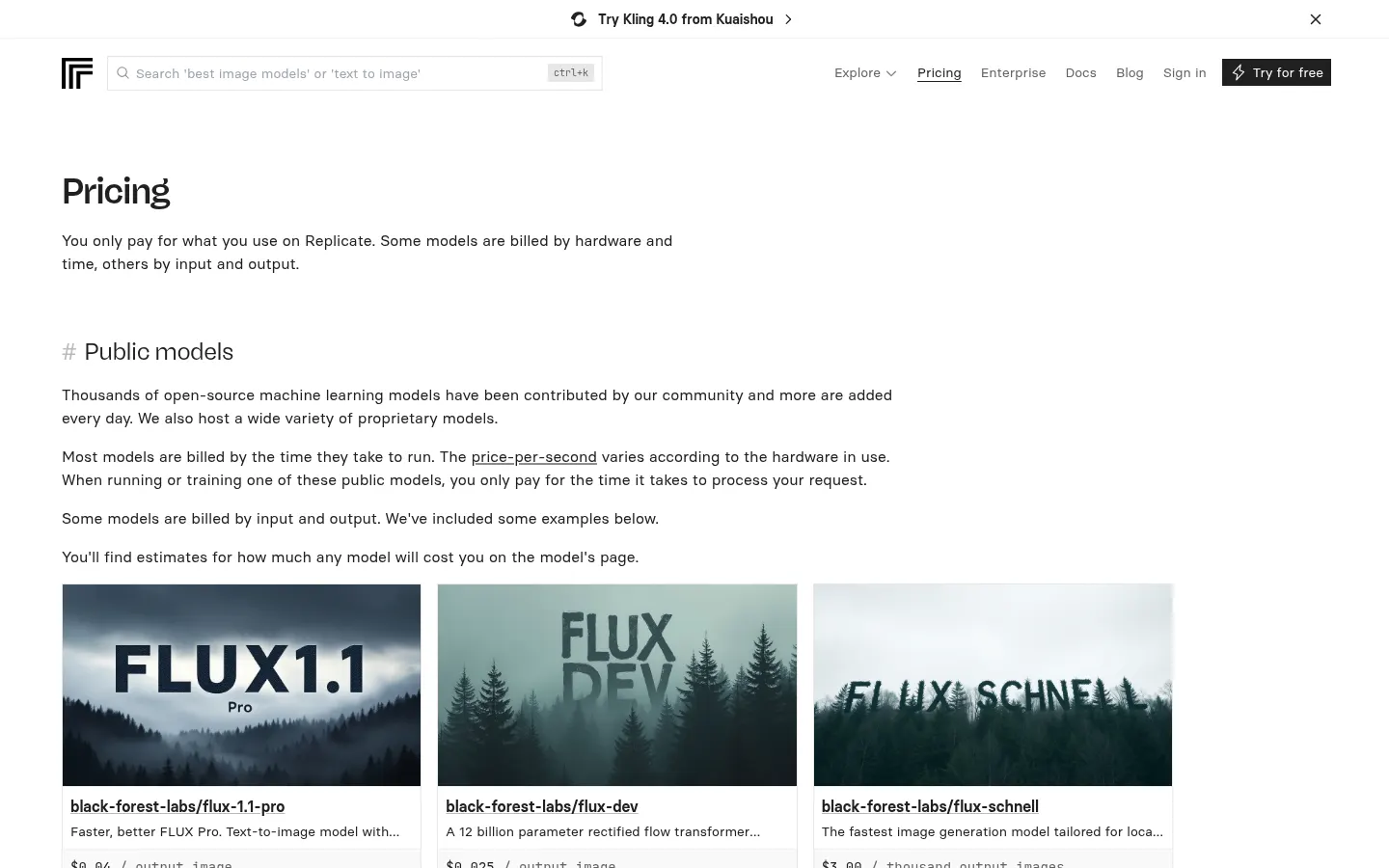
It is pay-as-you-go: some models are billed per image or per second of video and others per second of hardware, from $0.000025.
Which models can I use on Replicate?
Image, video, speech, music and language models from labs like Black Forest Labs, Google, OpenAI or ByteDance, plus thousands of community models.
Can I train my own model on Replicate?
Yes, you can fine-tune existing models on your data and deploy your own models or code.
Do I need to manage servers or GPUs?
No, Replicate handles the infrastructure and scales with demand.
What is the difference between public and private models?
With public models you pay only for your request time; private models run on dedicated hardware billed while the instance is up.
Which languages work with Replicate?
It offers Python and Node.js clients plus an HTTP API callable from any language.
Can I publish my model on Replicate?
Yes, researchers and developers publish models so others can run them through a working API.
What are the best Replicate alternatives?
On GptZone you can compare it with fal Agent, RunPod, Modal and Baseten.co for deploying your own models.
Replicate pricing and plans
Pay-as-you-go in US dollars (USD). Checked on: 02/11/2026.
Many official models are billed per output: for example flux-1.1-pro at $0.04 per image, flux-dev at $0.025 per image and wan-2.1 720p at $0.25 per second of video.
Other models are billed by processing time based on hardware, from $0.000025 per second.
Private models on dedicated hardware are billed for all the time the instance is up; fast-booting fine-tunes only while processing.
Extra multi-GPU capacity (A100, H100, H200, L40S) is available with committed spend contracts.
Replicate Screenshots
Replicate user reviews
Write a review
Checking your session...
Replicate Reviews
Loading reviews...
Replicate alternatives






OpenRouter
OpenRouter is a unified API that connects to 600+ text, image, video and audio models from 80+ providers with a single key and a single balance.