
Share
What is ScraperAPI?
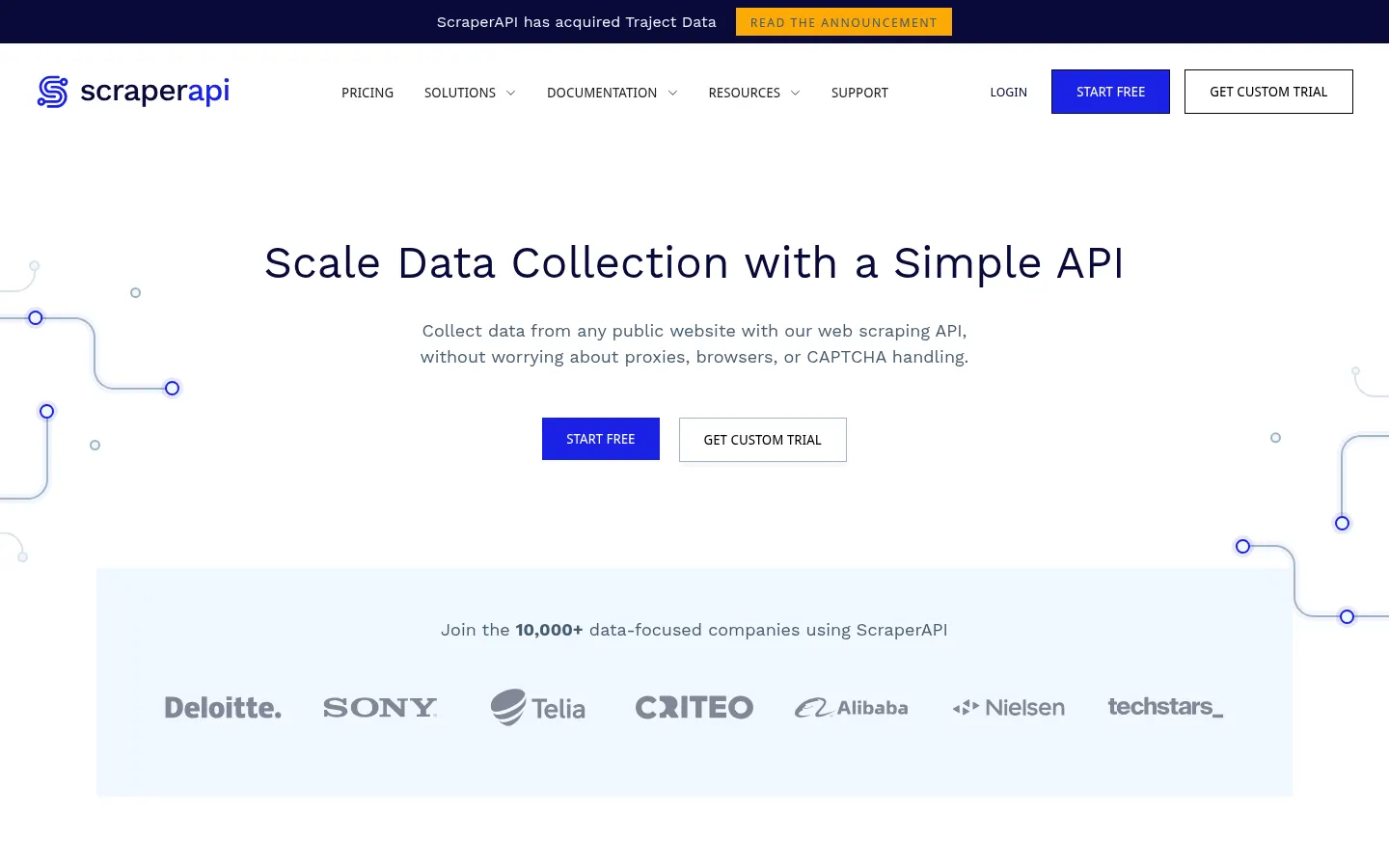
ScraperAPI is a data/AI tool by ScraperAPI that provides a web scraping API to collect public data at scale without running your own proxy, browser or CAPTCHA stack.
What is ScraperAPI used for?
You send a URL to the API and get clean HTML or JSON back. It includes rotating proxies (40M+ across 50+ countries), JavaScript rendering, automatic retries and antibot bypass. Structured endpoints cover Amazon, Google Search/Shopping/News/Jobs, Walmart and other high-demand domains, plus an async scraper for millions of jobs.
How does it fit data pipelines?
DataPipeline automates collection without writing every scraper by hand. There is also an AI parser, LLM-agent integrations and stated CCPA/GDPR compliance. It fits ecommerce, SEO, real-estate research or model training that needs fresh web data with geotargeting.
- Data teams scraping marketplaces or SERPs at high volume.
- SEO agencies monitoring rankings and search results.
- Developers who want one API instead of maintaining proxy farms.
Documentation and the dashboard help you track day-to-day usage without relying on external spreadsheets.
It is also worth checking the technical limits published on the official site before rolling it out in production.
Before rolling it out to the team, compare integrations, UI languages and technical limits described in the official docs, and run through a full workflow with a real day-to-day example to confirm it fits how you already work.
ScraperAPI pros and cons
Pros: a simple API, ready-made JSON endpoints and a global proxy pool. Cons: credit use varies by domain (Amazon, Google or LinkedIn use more credits than a standard page) and unused credits do not roll into the next cycle.
ScraperAPI features and use cases
How to use ScraperAPI
ScraperAPI FAQ
What is ScraperAPI?
It is a web scraping API that handles proxies, CAPTCHAs and JS rendering, and can return HTML or structured JSON from popular domains.
Is ScraperAPI free?
There is a tier with 1,000 credits and a 7-day trial with 5,000. Paid packages start at Hobby. See the pricing section.
Does it have an API?
Yes: ScraperAPI itself is the product (sync, async and structured endpoints), with a key after signup.
Does it work in Spanish?
Docs and marketing are in English; you can scrape Spanish pages and use country-level geotargeting.
Is one credit always one request?
A standard page costs 1 credit, but Amazon, Google, LinkedIn or antibot bypass cost more per the site’s table.
Do credits roll over?
No. They reset each billing cycle.
Can I scrape JavaScript pages?
Yes. You can enable JS rendering for dynamic pages and still get HTML or parsed JSON.
Is it CCPA and GDPR compliant?
The site states 100% CCPA and GDPR compliance.
What are the alternatives to ScraperAPI?
On GptZone you can compare Apify and Browserbase for web data collection and browser automation.
ScraperAPI pricing and plans
Reference price: 49 USD / month. Source · Verified: November 6, 2026
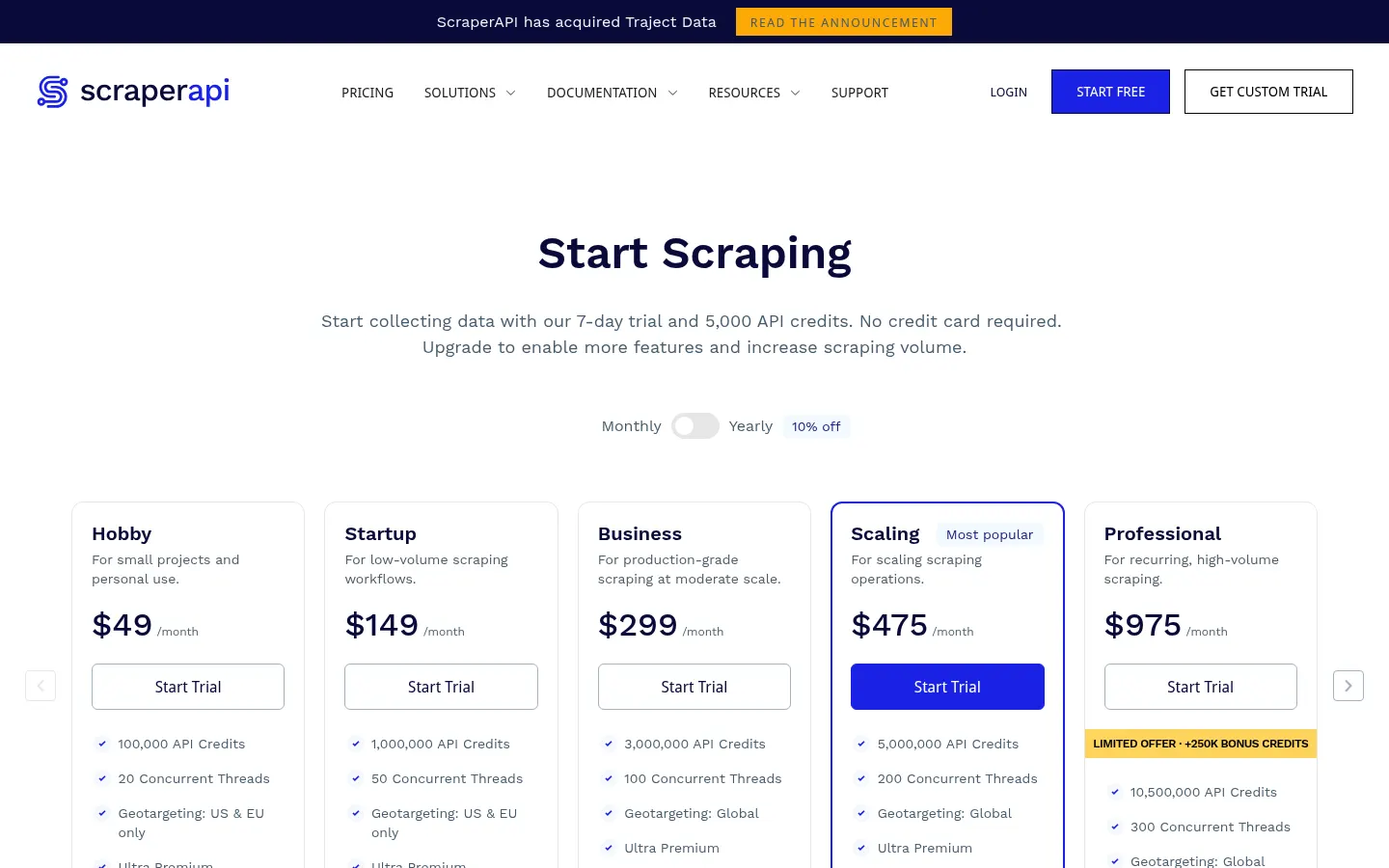
USD prices from the official page (Checked on: 06/11/2026). 7-day trial with 5,000 credits and no card; also 1,000 credits on the permanent free tier. Yearly ~10% off.
- Hobby: $49/month ($44.10 yearly); 100k credits; 20 threads; US/EU geo.
- Startup: $149/month ($134.10); 1M credits; 50 threads.
- Business: $299/month ($269.10); 3M credits; 100 threads; global geo.
- Scaling: $475/month ($427.50); 5M credits; 200 threads; pay as you go.
- Professional: $975/month ($877.50); 10.5M credits; 300 threads.
- Advanced: $1,975/month ($1,777.50); 21.5M credits; 500 threads.
- Enterprise: custom.
A standard page = 1 credit; Amazon 5; Google/Bing 25; LinkedIn 30; antibot +10. Credits do not roll over.
ScraperAPI Screenshots
ScraperAPI user reviews
Write a review
Checking your session...
ScraperAPI Reviews
Loading reviews...
ScraperAPI alternatives






ScrapingBee
API that scrapes websites without managing proxies or browsers: renders JavaScript, avoids blocks and returns HTML, Markdown or JSON via AI extraction.