
Share
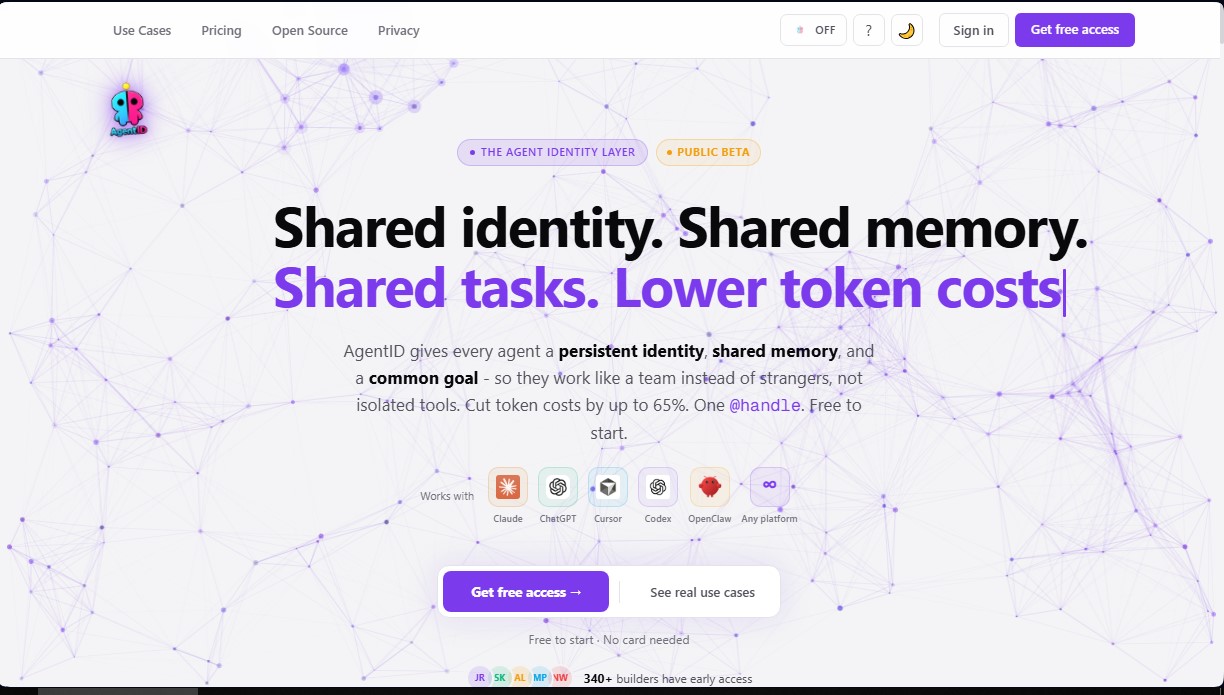
Identity and shared memory layer for AI agents. Enables cross-platform teamwork and reduces token costs by up to 65%.
What is AgentID?
AgentID is a specialized infrastructure that acts as an identity layer for AI agents, allowing different virtual assistants to share a common personality, memory, and objectives. Its primary function is to eliminate the information silos that occur when using multiple AI tools in isolation. By using a unique identifier (@handle), this solution provides agents with persistent memory that survives session restarts and platform changes, transforming individual tools into a coordinated team.
AgentID technology integrates natively with advanced language models such as Claude, ChatGPT, Cursor, and Codex. It operates by injecting dynamic prompts and utilizing open protocols like MCP (Model Context Protocol), HTTP APIs, and a TypeScript SDK. This enables any agent—whether on a local computer or in an autonomous deployment—to query and write to a shared memory pool.
Key functional capabilities include:
- Identity and Voice Persistence: Ensures the agent maintains the same tone, beliefs, and communication patterns across all sessions and connected tools.
- Shared Memory Management: What one agent learns or records is immediately accessible to others, eliminating the need for users to constantly repeat context.
- Multi-Agent Tasks and Handoffs: Enables a common goal to be assigned to several assistants. An agent can declare the start of a mission, update its progress, and perform a structured information handoff to another agent to continue the work.
- Token Optimization with Caveman Mode: This prompt compression feature automatically reduces the size of system instructions by up to 65%, saving on API costs without sacrificing technical accuracy.
- Real-Time Monitoring: Through the Studio dashboard, users can monitor their agent fleet's activity in real time, visualizing tool calls, memory updates, and change history.
AgentID is especially useful for developers managing autonomous agent fleets, power users of AI coding tools, and enterprises that require multi-agent coordination with a clear audit trail.
In terms of security, the platform employs AES-256 encryption at rest and TLS 1.3 connections. Identity and memory data are protected through token-based access and are never used to train external models, ensuring user privacy. Furthermore, many of its components are open source, facilitating scalability in AI workflows and seamless integration into custom infrastructures.
AgentID features and use cases
How to use AgentID
AgentID FAQ
What exactly is AgentID and what does it do?
It is an identity layer that provides your AI agents with a persistent personality, shared memory, and common goals, allowing them to work as a coordinated team.
What’s the difference between an agent and an identity in AgentID?
An agent is the execution environment that performs tasks, while an identity defines who that agent is—including its voice, beliefs, and mindset—across various platforms.
How does AgentID help lower token costs?
With Caveman Mode, the tool automatically compresses system instructions by stripping away unnecessary fluff, allowing you to save up to 65% on token usage.
Can I share information between an agent in Claude and another in Cursor?
Yes. Through AgentID’s shared memory, all agents linked to the same identity can access what others have learned, eliminating the need to constantly repeat context and data.
What security measures does AgentID use to protect my data?
Data is encrypted at rest and in transit, access is secured via individual tokens, and your information is never used to train external AI models.
What’s included in the free version of AgentID?
The free plan allows you to create two identities and connect up to four agents. It includes access to shared memory, MCP protocol support, and all export formats.
How do shared tasks work on the platform?
They let you assign a single objective to multiple agents, which can then communicate their progress and perform structured handoffs in real time directly from the dashboard.
Can I use AgentID with my own custom agent?
Yes. Any agent capable of making an HTTP request can load an AgentID identity via the export URL to integrate it into its system instructions.
AgentID pricing and plans
Free forever
€0 per month
- 2 identities.
- 4 agents.
- MCP connection.
- Shared memory.
- All export formats.
Pro
€3.99 per month
- Unlimited identities.
- Unlimited agents.
- Unlimited memory.
- Unlimited tasks.
- MCP connection.
- All export formats.
- Caveman Mode (token compression).
- Priority support.
AgentID Screenshots
AgentID alternatives


localscreenshot
localscreenshot is a screenshot API and MCP server for AI agents, returning clean captures of any web page on phone or desktop from 227 countries.



Nuclr Commander
Workspace for running multiple AI agents in parallel with a file manager. Supports local or external models and remote mobile monitoring.