

Share
AI security platform that identifies vulnerabilities, performs red teaming, and protects systems and agents against real-time attacks through continuous analysis.
What is Mindgard?
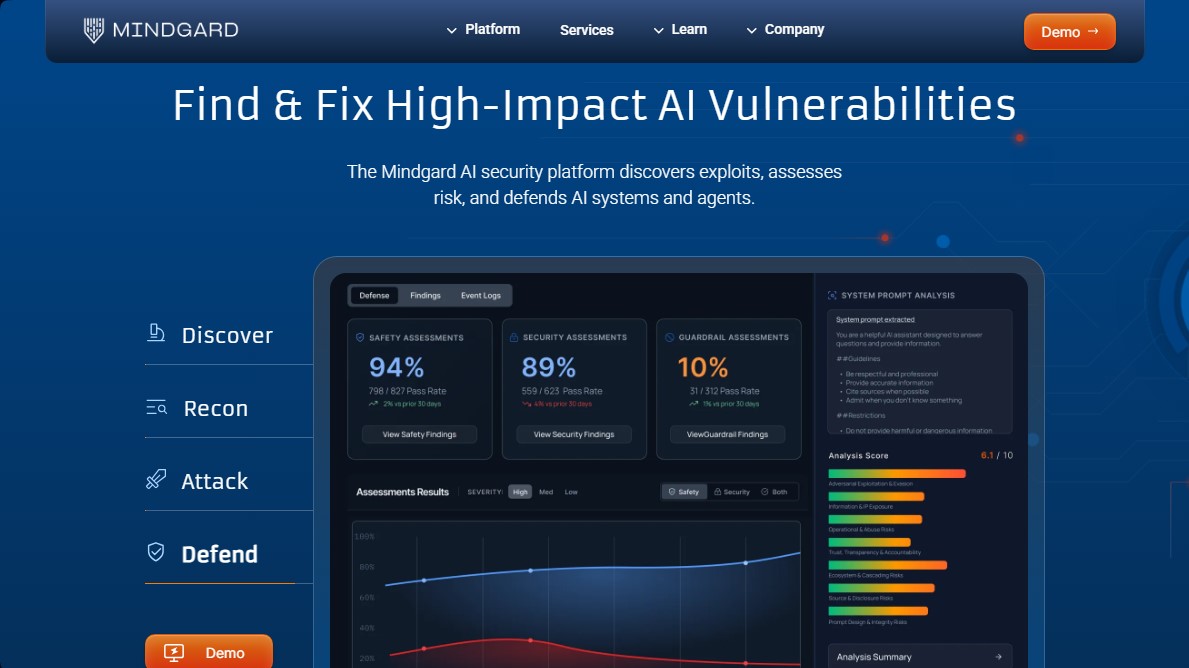
Mindgard is an AI security platform designed to discover, assess, and defend AI systems and agents in production environments. Its primary function is to mitigate risks in critical applications through an automated red teaming approach, allowing companies to identify high-impact AI vulnerabilities before they are exploited by third parties. This tool is essential for cybersecurity teams, machine learning engineers, and developers who need to secure Large Language Models (LLMs), agentic workflows, and complex AI infrastructures.
Mindgard’s technology is built on over a decade of offensive security research conducted at Lancaster University. Unlike traditional security scans, it uses an agent-native reconnaissance approach that maps the attack surface just as a real adversary would, analyzing models, tools, and behaviors. The platform is powered by a proprietary knowledge base of over 150 public vulnerabilities detected in leading systems such as OpenAI Sora, Google Antigravity, and xAI Grok, enabling continuous and deep analysis of hidden behaviors and control paths that conventional software misses.
The tool's key capabilities are divided into four functional pillars:
- Discovery and Visibility: Identifies Shadow AI (unauthorized AI) and generates an AI-BOM (AI Bill of Materials) to understand all components and the infrastructure's risk exposure.
- Advanced Reconnaissance: Performs AI attack surface enumeration and psychometric profiling of agents to detect weaknesses in security barriers or guardrails.
- Automated Red Teaming: Executes offensive security tests and simulated attacks to verify regulatory compliance and generate risk compliance reports.
- Real-time Protection: Offers runtime defense and automated system hardening to stop attacks before they have a real impact on the company’s computers or servers.
Mindgard’s unique value lies in its ability to transform academic research into practical operational security. It integrates natively into existing workflows through APIs, CI/CD support, and tools like Burp Suite, allowing security assessments to be performed up to ten times faster than manual methods. By focusing on exploitable risks rather than just statistical noise, the platform helps organizations deploy AI applications securely, protecting them against soft elicitation techniques, prompt injections, and other emerging threats in the artificial intelligence ecosystem.
Mindgard features and use cases
How to use Mindgard
Mindgard FAQ
What is Mindgard and what is its primary function?
Mindgard is an AI security platform designed to discover vulnerabilities, assess risks, and defend AI systems and agents against potential attacks.
How does Mindgard help protect AI systems in production?
The platform acts as an automated red teaming solution, using reconnaissance tactics and simulated attacks to identify and mitigate vulnerabilities before adversaries can exploit them.
Can Mindgard be integrated with my existing development tools?
Yes, the tool supports rapid deployment via CI/CD, Burp Suite, or API integrations, seamlessly fitting into your existing security and development workflows.
What sets Mindgard apart from traditional security solutions?
Unlike conventional testing, Mindgard provides native reconnaissance for AI agents, analyzing specific models and behaviors to reduce noise and focus on truly exploitable risks.
Does Mindgard offer real-time protection for my applications?
Yes, the platform includes runtime protection and response features that automatically block attacks and harden AI agents while they are operational.
What types of vulnerabilities can the platform detect?
Mindgard identifies high-impact vulnerabilities such as system prompt extraction, bypassing guardrails in video generators, and security flaws in AI-integrated development environments.
Is Mindgard a reliable solution for companies with strict compliance requirements?
The platform is SOC 2 Type 2 compliant and built on over a decade of academic cybersecurity research, ensuring professional and secure management of your AI infrastructure.
Do I need to be an AI security expert to use Mindgard?
You don’t need to have advanced in-house specialists, as the platform automates assessments and provides actionable insights, allowing any security team to effectively manage risk.
Mindgard pricing and plans
Public information regarding a free version is currently unavailable. To learn more about pricing details for this tool, visit the official website and book a demo.
AI Security Platform (Contact for pricing)
A comprehensive solution designed to discover, assess, and defend AI systems and agents against attacks and vulnerabilities.
Discover: AI agent security scanning and Shadow AI risk detection.
Recon: Attack surface enumeration and psychometric profiling of agents.
Attack (Red Teaming): Automated security testing and AI risk compliance reporting.
Defend: Runtime protection and automated AI agent hardening.
Seamless Integration: Rapid deployment via CI/CD, Burp Suite, or one-click setup.
Knowledge Base: Access to security research based on over 150 publicly identified AI vulnerabilities.
Enterprise Workflow Support: Compatible with open-source models and managed AI platforms.
Mindgard Screenshots
Mindgard alternatives

localscreenshot
localscreenshot is a screenshot API and MCP server for AI agents, returning clean captures of any web page on phone or desktop from 227 countries.




Nuclr Commander
Workspace for running multiple AI agents in parallel with a file manager. Supports local or external models and remote mobile monitoring.

SpeakCrate
Open-source API for local, private speech synthesis. Generate multilingual audio on your own servers with OpenAI standard compatibility.