
ReferenceChecker.ai
Share
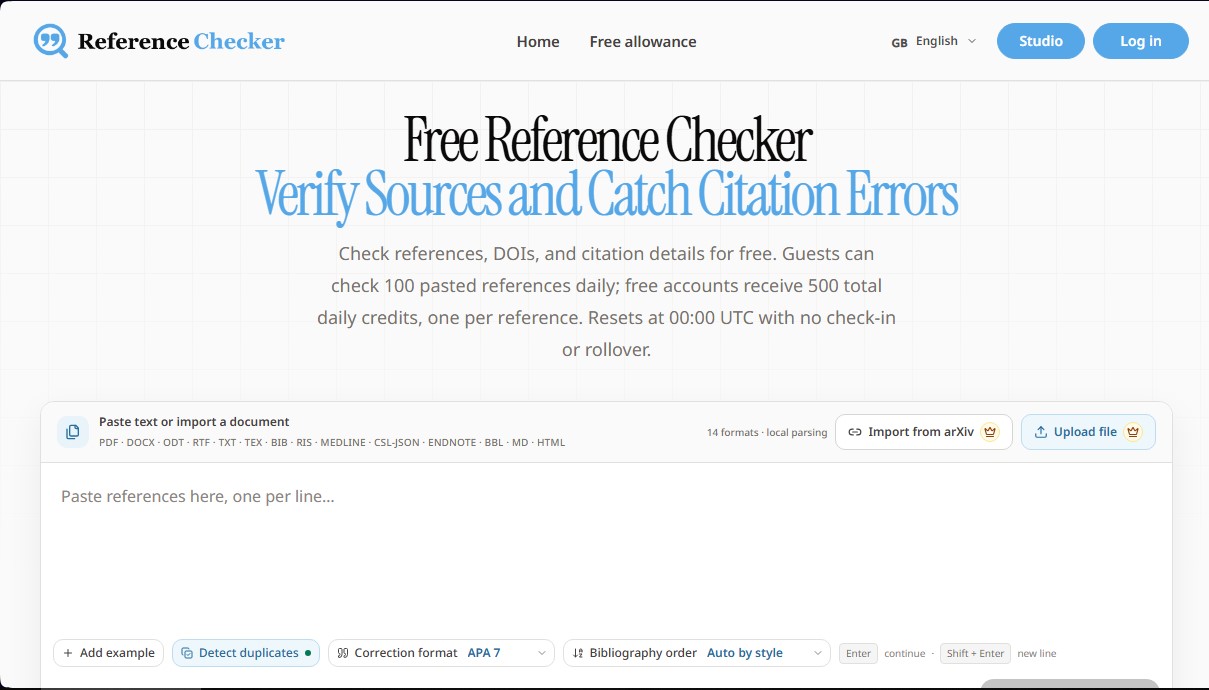
Verify academic citations and DOIs against scientific databases. Detect errors or fake references and correct bibliographies in multiple professional formats.
What is ReferenceChecker.ai?
ReferenceChecker.AI is a specialized tool for academic source verification and the detection of errors in bibliographic citations. Its primary function is to ensure the integrity of manuscripts and research papers by validating references against global scientific databases. This solution is essential for students, researchers, professors, and editors who need to confirm the accuracy of a DOI, author names, or publication titles before document submission or peer review.
The platform's operation is based on a structured technical process that begins with local in-browser analysis, ensuring privacy by processing data internally before confirmation. The tool breaks down each citation into structured fields and utilizes smart routing technology to connect with 12 highly prestigious academic data sources, such as Crossref, PubMed, arXiv, OpenAlex, and Semantic Scholar. Unlike conventional citation managers, ReferenceChecker.AI does not just focus on the aesthetics of the citation; it cross-references the information with the actual publication record to identify content discrepancies or fabricated data.
Key capabilities and practical benefits include:
- Field-by-field verification: Compares the title, volume, article number, and authors of the submitted reference against the original source record, highlighting any differences.
- Incorrect DOI identification: Detects identifiers that, while functional, point to a different article than the one mentioned in the text.
- Retraction alerts: Issues explicit warnings when a matching publication has been flagged as retracted in academic indexes.
- Duplicate detection: Locates repeated or highly similar entries by analyzing normalized identifiers (PMID, arXiv ID) and titles.
- Multi-format support: Allows for the import of complete bibliographies from 14 file formats, including PDF, DOCX, BibTeX, RIS, and LaTeX, as well as direct import from arXiv.
The platform facilitates bibliography correction by allowing users to apply changes based on scientific evidence without losing the original reference. Users can generate automatic corrections in seven fundamental citation styles, including APA 7, MLA 9, Chicago, Vancouver, and IEEE. By offering a workflow that links every decision to a verified publication record, ReferenceChecker.AI helps prevent errors derived from automated writing tools and ensures that every cited source is findable and legitimate within the academic sphere. Finally, it allows for the export of results and the generation of public reports to share the evidence of the review.
ReferenceChecker.ai features and use cases
How to use ReferenceChecker.ai
ReferenceChecker.ai FAQ
What is ReferenceChecker.AI and what does it do?
It is a tool designed to verify bibliographic references, validate DOIs, and detect citation errors by cross-referencing them with major official academic databases.
What are the limits for the free version of ReferenceChecker.AI?
Guest users can check up to 100 pasted references per day, while registered free accounts receive 500 daily credits that reset at 00:00 UTC.
Which file formats can I upload to analyze my bibliography?
The platform supports 14 different formats, including PDF, DOCX, TXT, BibTeX, RIS, LaTeX, and EndNote files, initially processing the data locally in your browser.
Can the tool detect fake citations generated by artificial intelligence?
Yes, the system identifies references that lack a real record in scientific databases, helping to filter out potential hallucinations or errors from language models.
Which citation styles can ReferenceChecker.AI correct?
Automatic corrections based on official sources can be applied to the most common styles, such as APA 7, MLA 9, Chicago, Harvard, Vancouver, IEEE, and ABNT.
How does the system notify me if an article in my list has been retracted?
The tool displays a clear warning signal and provides a link to the original source whenever a publication record is flagged as retracted in the queried databases.
What happens if a DOI is valid but does not match the article title?
The checker compares individual fields and issues an alert if the identifier resolves to a different work, allowing the user to correct the link before publishing their paper.
Do I need to register to use the service?
Registration is not required for basic checks of pasted text, though creating a free account allows you to upload files, download reports, and access an expanded activity history.
Which databases does ReferenceChecker.AI use to validate information?
The tool queries 12 trusted academic sources, including Crossref, PubMed, arXiv, OpenAlex, Semantic Scholar, and various open-access databases.
How is the privacy of uploaded documents handled?
File analysis is performed locally in the user's browser, and original content is only processed to generate the verification report after user confirmation.
ReferenceChecker.ai pricing and plans
Guest Access
Price: Free
Allows for up to 100 daily checks of pasted references.
No registration or credit card required.
Results are not saved to an account, and the usage limit is shared per network.
Free Account
Price: Free
Includes 500 daily credits (one credit per checked reference).
Import full bibliographies via files (14 formats including PDF, DOCX, BibTeX) or directly from arXiv.
Access to result export tools in five different formats.
Activity history management, verified reference library, and the option to share reports via public links.
Advanced duplicate detection features and automatic reordering based on citation style.
The credit limit resets daily at 00:00 UTC and does not roll over.
ReferenceChecker.ai Screenshots
ReferenceChecker.ai alternatives

MakeLesson
Transform educational materials into interactive, auto-graded lessons. Includes student management, scheduling, and payments in an all-in-one platform for teachers.