

Share
What is Lexi?
Lexi is an AI API proxy by LexiCo AS (Norway) that sits between your code and the model to cut the tokens each call sends. It is aimed at developers and teams running AI apps in production, especially chats or agents with long sessions, where every turn resends the whole history and spend keeps climbing.
What is Lexi and how does it reduce tokens?
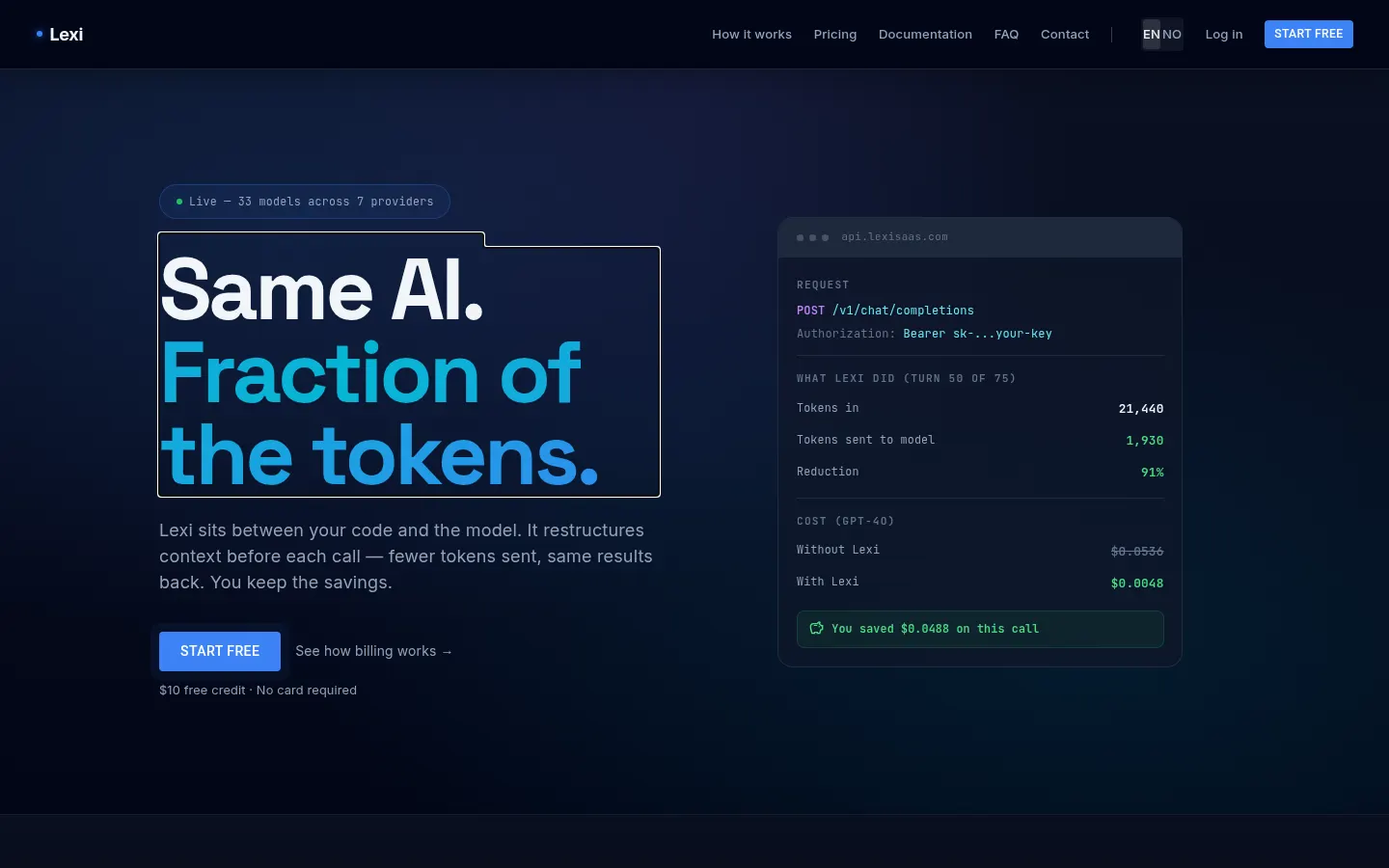
Its STONE engine (Semantic Token Optimization and Natural Encoding) restructures the conversation into a bounded form before it reaches the provider, so turn 50 sends roughly what turn 5 does. Numbers, dates and decisions are pinned into a permanent anchor, every message is archived encrypted, and for a specific question it retrieves only what the model needs to answer. In its 75-turn GPT-4o benchmark it cut tokens by 91.6%. If restructuring can't help, the original request goes through unchanged.
How do you integrate Lexi?
You swap the base URL in the OpenAI or Anthropic SDK for Lexi's and use its key. It supports 33 models from OpenAI, Anthropic, Google, Mistral, xAI, DeepSeek and Meta, detects the provider from the model name and passes streaming, tool calls and structured output through. Every response carries HTTP headers with original tokens, tokens sent, savings and balance, and it adds under 1 ms of latency.
Who is Lexi for?
- Teams running chatbots or agents with long sessions.
- Startups that want to rein in token spend without rewriting code.
- Developers who need per-request savings logged.
Lexi pros and cons
Pros: it only earns when you save, integration is a one-line change, and the worst case equals calling the provider directly. Cons: savings depend on the conversation pattern (short requests leave little room), its blind benchmark showed recall accuracy dropping from 9.0 to 8.4 out of 10 on peripheral detail, and your data passes through a third party.
Lexi features and use cases
How to use Lexi
Lexi FAQ
What is Lexi?
It is an LLM API proxy that restructures each call's context to send fewer tokens without changing the models you use.
Is Lexi free?
It is not free, but you get $10 of credit on sign-up and it only charges a share of what it saves you. See the pricing section.
How much can Lexi save?
In its 75-turn GPT-4o benchmark, 91.6% of tokens; on short conversations savings are much smaller.
Does it hurt answer quality?
Its blind benchmark scored 8.4/10 on recall versus 9.0/10 with full context, with gaps in peripheral detail.
Which models are supported?
33 models from OpenAI, Anthropic, Google, Mistral, xAI, DeepSeek and Meta, through one endpoint.
Does Lexi have an API and docs?
Yes, Lexi itself is an API compatible with the OpenAI and Anthropic SDKs, with a published reference and getting-started guide.
Does it work with prompts in Spanish?
It restructures context regardless of language, though its published benchmarks use English conversations.
Do streaming and tool calls still work?
Yes. Streaming, tool calls and structured output pass through the proxy unchanged.
Who makes Lexi?
Lexi is built by LexiCo AS, a company based in Norway.
What are Lexi alternatives?
Our directory lists OpenRouter, which unifies access to many models but does not focus on compressing context.
Lexi pricing and plans
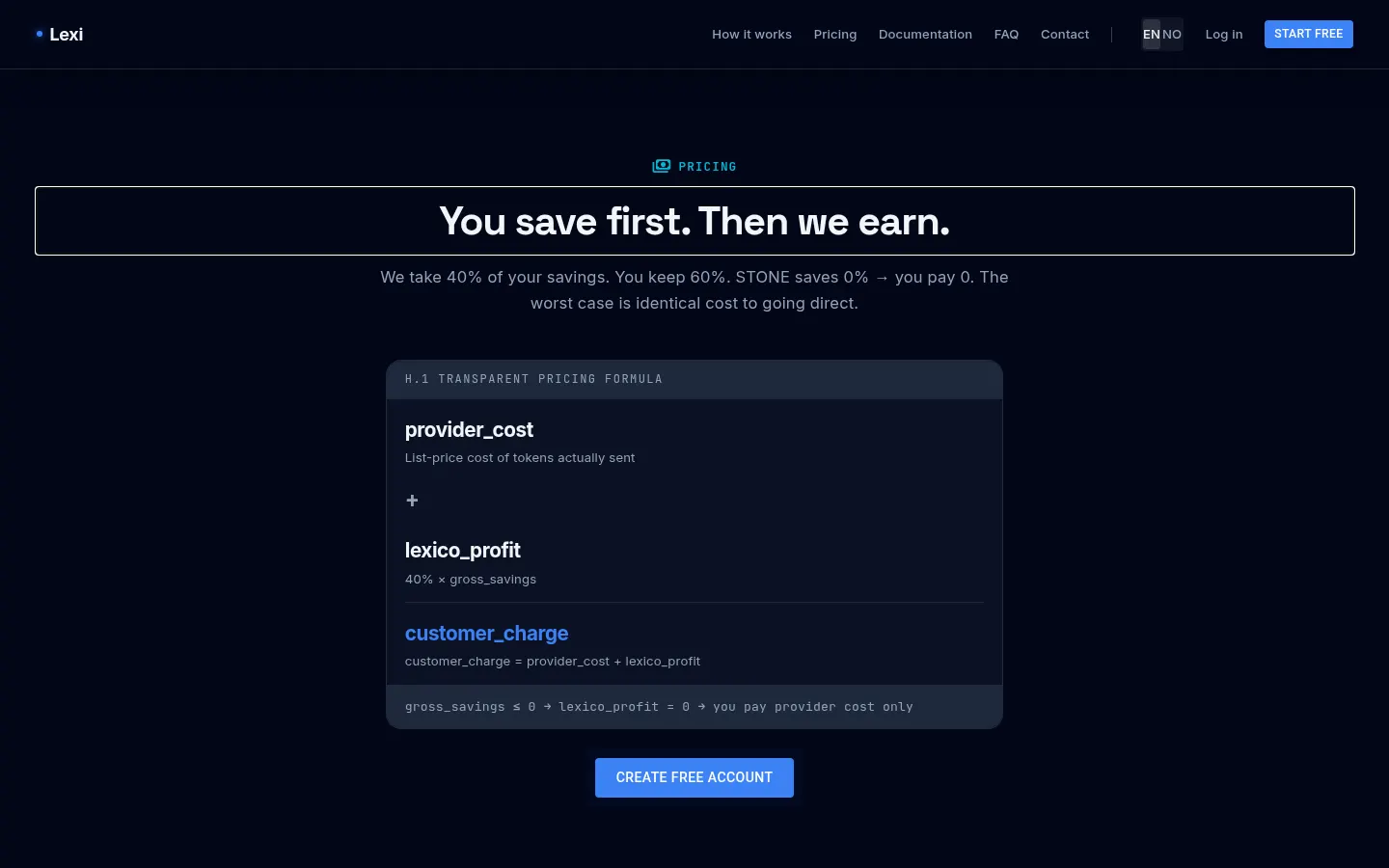
Prices in US dollars (USD) from the official website. Checked on: 20/11/2026. No fees or fixed plans: you pay the list price of the tokens actually sent to the provider plus 40% of the savings achieved (you keep 60%). If there are no savings, Lexi charges nothing extra and you pay the same as going direct.
Starting credit: $10 free on sign-up, no card.
Official calculator example: at 10M input tokens a month, $25 direct versus about $12 with Lexi ($3.50 provider + $8.60 fee). Results vary by content and conversation length.
Requests-per-minute limits rise automatically with lifetime spend (from 120 requests/minute on a free account).
Lexi Screenshots
Lexi user reviews
Write a review
Checking your session...
Lexi Reviews
Loading reviews...
Lexi alternatives

BuildPress
BuildPress is a desktop app where Claude Code or Codex builds real WordPress sites with Elementor or blocks on your computer, then you review and push them to your host.





Liquid Inference
Liquid Inference is an LLM inference exchange where providers compete in an instant auction to answer each request at the best price and quality.