
Share
What is Spanlight?
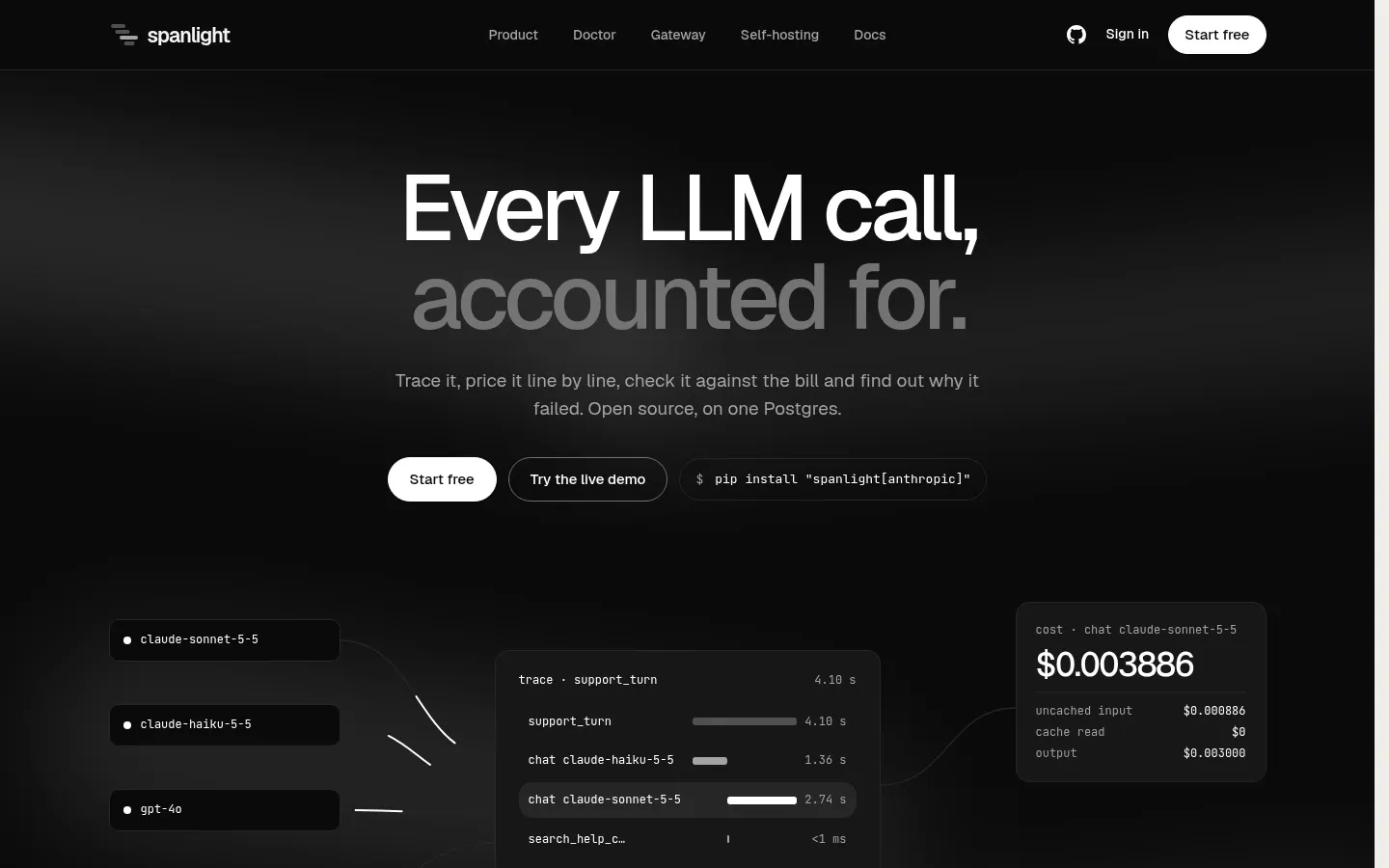
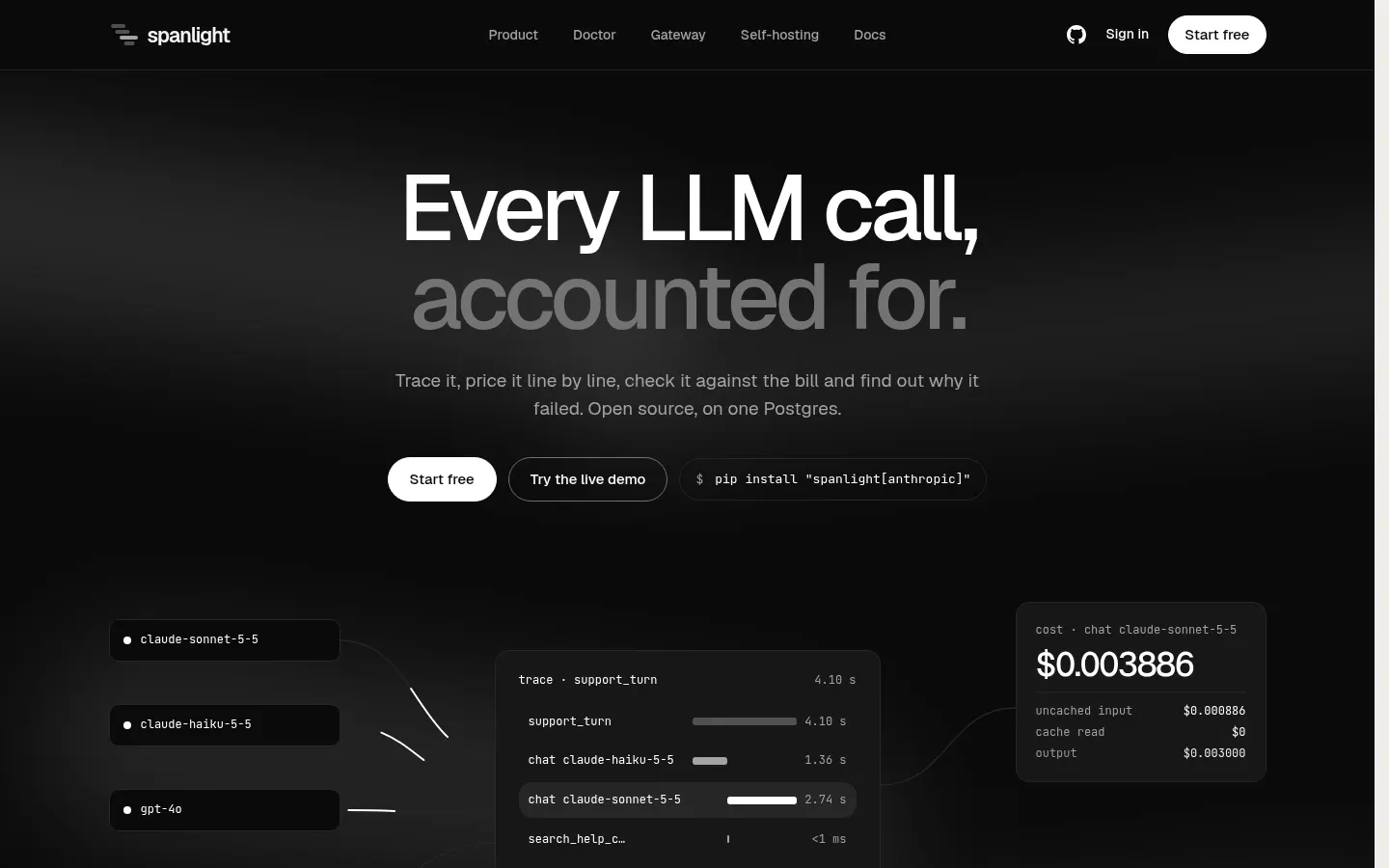
Spanlight is an open-source AI tool for LLM observability. It traces every call, computes its spend line by line, checks it against what your provider reports and helps you find out why it failed, all self-hosted on a single Postgres database.
What is Spanlight used for?
It shows what your AI apps and agents do and how much they spend. Each call lands within seconds with prompt, completion, latency, tokens and spend, and you can read a session turn by turn. When an amount cannot be known, Spanlight shows a dash with the reason, never a zero. Every day it compares traced data with Anthropic or OpenAI figures, and lets you attribute spend by customer, feature or team with metadata, plus budget scopes that alert or block.
How does Spanlight work?
Send traces with the Python SDK (wrapping your OpenAI or Anthropic client), any OTLP exporter (it reads GenAI conventions, OpenInference, OpenLLMetry and the Vercel AI SDK) or through its gateway, changing only the base URL. The gateway adds sealed credentials, retries and fallbacks, and per-key rate limits. Every 15 minutes the Doctor runs 16 detectors over your spans, such as repeated tool calls, misconfigured client timeouts or latency regressions, each with evidence and a suggested fix.
Who is Spanlight for?
- Teams shipping LLM apps and agents to production.
- Developers debugging failures in model calls.
- Managers who need to attribute AI spend.
- Companies that prefer to self-host observability.
Spanlight pros and cons
It includes prompt management with versions, labels, a playground and exact replay of recorded calls, evals with 95% confidence intervals and a nightly queue of traces worth reading. Its core is MIT licensed and deploys with Docker Compose. On the downside, the server is still a pre-1.0 release.
Spanlight features and use cases
How to use Spanlight
Spanlight FAQ
What is Spanlight?
Spanlight is an open-source LLM observability platform that traces calls, computes their spend and detects failures.
Is Spanlight free?
It is open source and self-hostable with no paid license; details are in the pricing section.
How do I send traces?
With the Python SDK, any OTLP/HTTP exporter or through the gateway by changing the base URL.
What is the Doctor?
A set of 16 detectors that check your spans every 15 minutes and return evidence, a suggested fix and a way to verify it.
How does it reconcile spend with my provider?
It compares traced data daily with figures pulled using an Anthropic or OpenAI admin key, or a CSV upload.
What do I need to host it?
Docker Compose and Postgres, its only datastore, job queue included.
Can it evaluate prompts?
Yes, with versions, a playground, exact replay and evals with pass rates and 95% confidence intervals.
Does Spanlight have an API?
Yes, an API reference, an OTLP endpoint at /v1/otlp/traces and a gateway compatible with OpenAI and Anthropic APIs.
Does Spanlight work in Spanish?
The interface and docs are in English; traces record content as sent, in any language.
What are the alternatives to Spanlight?
In our directory you can compare it with Langfuse and Arize AX for LLM observability, or Evalship for evals.
Spanlight pricing and plans
Reference amounts in US dollars (USD). Checked on: 17/11/2026.
Spanlight is open source (MIT-licensed core) and self-hosted on Postgres with no license fee. The site does not publish prices for a hosted version; server costs are on you.
Spanlight Screenshots
Spanlight user reviews
Write a review
Checking your session...
Spanlight Reviews
Loading reviews...
Spanlight alternatives



Liquid Inference
Liquid Inference is an LLM inference exchange where providers compete in an instant auction to answer each request at the best price and quality.