Share
AI memory layer connecting documents and history to model context. Save tokens and improve the quality of generated responses.
What is GoodMem?
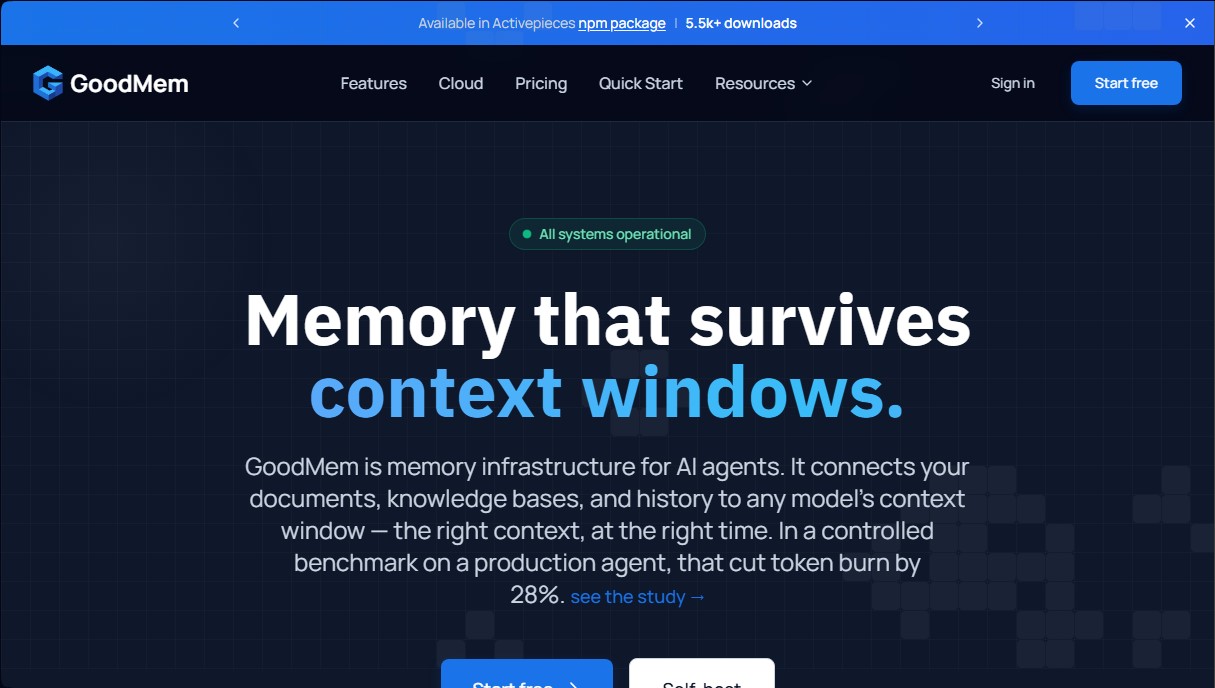
GoodMem is an AI agent memory infrastructure designed to optimize how language models access external information. Its primary function is to connect documents, knowledge bases, and interaction histories directly to any model's context window, ensuring the agent receives precise information exactly when needed. This tool allows virtual assistants to maintain a persistent and searchable memory, overcoming the capacity limitations of traditional prompts.
GoodMem operates on an advanced Retrieval-Augmented Generation (RAG) system. The platform processes original files, extracts their content, chunks it, and indexes it using embeddings. One of its key technologies is the Retrieval Optimizer, a utility that compares different embedding models and rerankers using real-world queries to determine which provides the highest relevance. The system doesn't just store data; it manages the retrieval of specific chunks while citing the original source, improving the traceability and accuracy of AI-generated responses.
This solution is particularly useful for developers building enterprise RAG systems, technical support assistants, or complex multi-agent workflows. Key operational benefits include:
- Token cost reduction: By providing only the strictly necessary context instead of full histories, it can reduce token consumption by approximately 28%.
- Reasoning efficiency: It minimizes intermediate agent steps (up to 23% fewer in performance tests) without sacrificing response quality.
- Security and governance: It offers strict control through user roles, scoped API keys, and audit logs for every data retrieval.
- Cross-platform compatibility: Official SDKs are available for Python, TypeScript, Java, .NET, and Go, facilitating integration into any development environment.
GoodMem stands out for its deployment flexibility. It can be used as a managed cloud service or through self-hosting with Docker and virtual machines, allowing the AI’s memory to reside behind the client’s firewall if necessary. It is compatible with leading providers such as OpenAI, Anthropic (Claude Code), and AWS Bedrock, while also offering top-tier support for open-model infrastructures like Ollama, vLLM, and OpenRouter.
The tool integrates natively into ecosystems like the Claude Code marketplace and Google Cloud Marketplace, solidifying its position as a robust persistence layer for intelligent agents that need to handle large volumes of data efficiently and securely on a computer or corporate server.
GoodMem features and use cases
How to use GoodMem
GoodMem FAQ
What exactly is GoodMem, and what is it used for?
It is a memory infrastructure for AI agents that connects your documents and knowledge bases to the context window of any model.
How does GoodMem help reduce my agents' token costs?
By retrieving only the relevant context instead of sending the entire conversation history, it allows you to save approximately 28% in token consumption.
Is GoodMem free to use for commercial projects?
The self-hosted version is completely free for commercial use, while the cloud version offers a 14-day free trial with no credit card required.
Can I install GoodMem on my own servers?
Yes, you can choose the managed cloud version or self-host it on your own infrastructure behind a firewall, maintaining full control over your data.
Which programming languages are compatible with GoodMem?
The tool offers official support and specific libraries for Python, TypeScript, Java, Go, and .NET environments.
What is considered a "memory" within the system?
A memory is an original document, including its content and metadata, that the system processes, chunks, and indexes for semantic retrieval.
Is GoodMem an open-source solution?
The server is proprietary software distributed under a free binary license, although the client SDKs are published as open source.
What advantages does the GoodMem Cloud retrieval optimizer offer?
This feature automatically compares different embedding models and rerankers against your actual queries to determine which one provides the best accuracy.
Is it possible to integrate GoodMem with local models like Ollama?
Yes, the tool allows you to switch providers and mix local infrastructure with the cloud, supporting both frontier models and local solutions like Ollama or vLLM.
How does pay-as-you-go billing work for the cloud version?
The service is billed by the second of instance uptime and allows you to pause processing so you only pay for data storage when it is not in use.
GoodMem pricing and plans
Self-hosted
Precio: Free.
Features:
Free for commercial use in SaaS and internal operations.
Royalty-free distribution for Docker, virtual machines, and local installers.
Unlimited memory per node (no artificial limits, subject only to user hardware).
High-performance, low-latency gRPC API.
SDKs available for Python, Java, Go, JS, and .NET.
GoodMem Cloud
Precio: Starting at 15 $ per month (pay-as-you-go).
Features:
14-day free trial, no credit card required.
Auto-Optimizer: continuous data tuning to automatically maximize relevance.
Fully managed hosting with instant provisioning.
Per-second billing while the instance is running.
Option to pause the instance to pay only for data storage.
Configurable spend caps for optimization tasks.
Enterprise
Precio: Visit the official website for a custom quote.
Features:
MSP and reseller licensing to offer GoodMem as a managed service.
Commercial IP indemnification.
White-label and OEM rights to remove GoodMem branding.
Source code access for security and compliance audits.
Managed High Availability with a 99.99% uptime SLA and 24/7 incident response.
GPU-accelerated OCR for processing text in scanned PDFs and images.
GoodMem Screenshots
GoodMem user reviews
Write a review
Checking your session...
GoodMem Reviews
Loading reviews...
GoodMem alternatives
Sprite Fusion
Generate and animate professional pixel art for games using AI. Create sprites, character sheets, and normal maps with direct export to Unity and Godot.

Redditapis
API to read, post, vote, and DM on Reddit without app reviews. Pay-as-you-go pricing, no subscription, and fast setup for AI agents.

LaunchProof
Audit websites across various browsers and devices to detect security, performance, or accessibility flaws, offering reports with solutions to fix them.
ParseCrate
Open-source, self-hosted document processing API. Converts PDFs and Office files into structured content with OCR and table detection for AI applications.
Together Link
Connect coding agents to open models to cut costs. Keep your existing tools and settings while optimizing token usage in every session.