
Share
Kiro
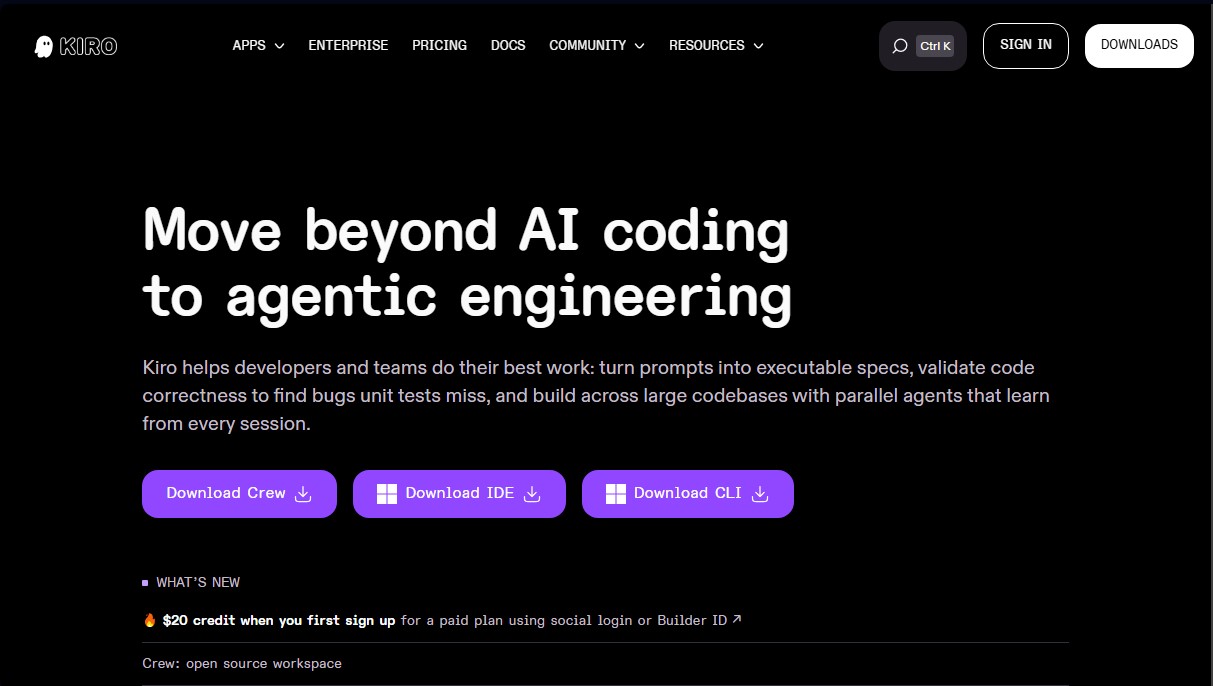
Agentic engineering platform that transforms prompts into specs, validates code, and autonomously automates development across large codebases.
General Information about Kiro
Kiro is an agent engineering platform designed to transform the software development lifecycle through advanced artificial intelligence. Unlike traditional coding assistants, this tool enables an evolution from simple prompts into executable specifications, facilitating the management of extensive codebases through intelligent agents that learn during every work session. Its core methodology is spec-driven development, which organizes the process into detailed requirements, architectural designs, and sequenced tasks before final implementation, avoiding the inaccuracies of intuition-based development.
Kiro’s operation relies on the constant validation of code correctness. It uses automated reasoning techniques to detect contradictions or gaps in initial requirements. Additionally, it implements property-based testing, an approach similar to fuzzing that verifies logical rules across all possible inputs, identifying critical errors that conventional unit tests often miss.
The tool's versatility is reflected in its various access interfaces:
- Kiro IDE: A development environment based on Code OSS, fully compatible with the VS Code extensions, themes, and settings already on the user's computer.
- Kiro CLI: A command-line tool designed to integrate into terminal workflows and CI/CD pipelines, enabling automated Pull Request reviews and bug fixes.
- Web Platform: An environment for delegating tasks in isolated cloud sandboxes, capable of autonomously coordinating changes across GitHub and GitLab repositories.
On the technical side, Kiro allows users to choose from various language models, such as Anthropic Claude (Opus, Sonnet, Haiku), DeepSeek, or MiniMax. Its Auto feature dynamically selects the most efficient model based on task complexity, latency, and cost. The platform is compatible with open standards like the Agent Client Protocol (ACP) and the Model Context Protocol (MCP), supporting over 500 popular CLIs and languages including Python, Rust, Go, TypeScript, Java, and C++.
Thanks to its AWS-backed infrastructure, it offers enterprise-grade security with SSO and IAM authentication. It is an ideal solution for teams looking to automate workflows, improve system architecture, and reduce delivery times for tech products, ensuring the resulting code is maintainable, scalable, and faithful to the original specifications. Its ability to work with parallel agents allows it to tackle complex tasks simultaneously, optimizing development resources for large-scale projects.
Features and Use Cases of Kiro
How Kiro Works
Frequently Asked Questions about Kiro
What is Kiro and how does it help with software development?
Kiro is an agentic AI with IDE, CLI, and web interfaces that transforms prompts into detailed specifications, executable code, documentation, and automated tests.
Which programming languages are supported by Kiro?
The tool supports a wide variety of languages, including Python, Java, JavaScript, TypeScript, Rust, Go, C#, PHP, Ruby, and various scripting environments.
Do I need an AWS account to use Kiro?
An AWS account is not required, as you can sign up and log in using your GitHub or Google accounts, or via an AWS Builder ID.
How does specification-based development work in Kiro?
This approach allows the tool to define requirements and architectural designs before writing any code, ensuring the final result aligns perfectly with the initial plan.
Can I import my VS Code extensions and settings into Kiro?
Yes, since Kiro is based on Code OSS, you can easily import your themes, configurations, and Open VSX-compatible extensions during the initial setup process.
How is Kiro's usage billed?
Kiro uses a credit-based pricing model that provides access to various AI models without daily limits, helping you avoid unexpected charges on your bill.
What is the difference between the IDE and the web version of Kiro?
The IDE is designed for real-time local development, while the web version allows you to delegate tasks to cloud sandboxes that keep running even after you close your browser.
Kiro Pricing
KIRO FREE
$0 per month
50 credits.
Access to open-source models (Qwen3 Coder Next, DeepSeek v3.2, MiniMax 2.1).
Access to Claude Sonnet 4.5.
Subject to rate limits.
KIRO PRO
$20 per user per month
1,000 credits.
Access to premium models (Auto, Claude Sonnet 4.6, and Claude Opus 4.8).
Additional credits at $0.04/credit.
Consolidated billing for team members.
Usage analytics and reporting.
SSO (SAML/SCIM) via AWS IAM Identity Center.
Organization management dashboard.
Enterprise security and privacy controls.
KIRO PRO+
$40 per user per month
2,000 credits.
Access to premium models (Auto, Claude Sonnet 4.6, and Claude Opus 4.8).
Additional credits at $0.04/credit.
Consolidated billing for team members.
Usage analytics and reporting.
SSO (SAML/SCIM) via AWS IAM Identity Center.
Organization management dashboard.
Enterprise security and privacy controls.
KIRO PRO MAX
$100 per user per month
5,000 credits.
Access to premium models (Auto, Claude Sonnet 4.6, and Claude Opus 4.8).
Additional credits at $0.04/credit.
Consolidated billing for team members.
Usage analytics and reporting.
SSO (SAML/SCIM) via AWS IAM Identity Center.
Organization management dashboard.
Enterprise security and privacy controls.
KIRO POWER
$200 per user per month
10,000 credits.
Access to premium models (Auto, Claude Sonnet 4.6, and Claude Opus 4.8).
Additional credits at $0.04/credit.
Consolidated billing for team members.
Usage analytics and reporting.
SSO (SAML/SCIM) via AWS IAM Identity Center.
Organization management dashboard.
Enterprise security and privacy controls.
TEAMS / ENTERPRISE
Contact sales for pricing
Includes all organization management and security features.
Centralized billing and admin controls.
Option to request up to one free year of the Pro+ plan for startups (terms apply).
Kiro Screenshots