

Share
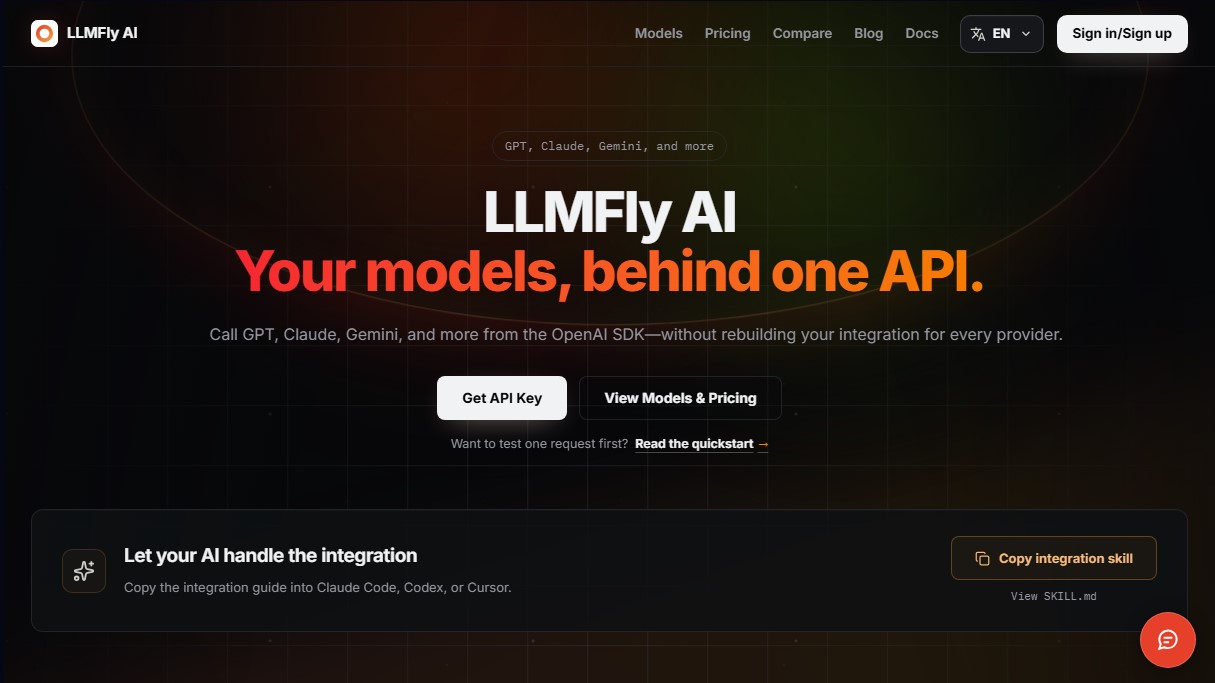
Access GPT, Claude, and Gemini via a single API compatible with the OpenAI SDK. Centralize provider management, simplify code, and reduce costs.
What is LLMFly AI?
LLMFly AI is an AI infrastructure solution that acts as a unified API gateway, allowing access to various large language models (LLMs) through a single connection point. Its technical objective is to simplify the integration of models from providers like OpenAI, Anthropic, Google, and xAI, eliminating the need to develop and maintain multiple code implementations for each individual service.
The tool works by enabling developers to use the OpenAI SDK to make calls to a wide range of models, including GPT-6 Astra, Claude, Gemini, and Grok. The implementation process is straightforward and involves three fundamental steps: creating an access key, updating the base URL in the server client, and selecting the desired model ID from the platform's catalog. This approach ensures that existing code remains functional while expanding the application's capabilities with new AI engines seamlessly.
From a functional standpoint, LLMFly AI offers key capabilities for professional project management and software development:
- Environment Segregation: The ability to assign independent keys for development and production applications, which enhances security by allowing specific access to be revoked in the event of leaks without disrupting other active services.
- Extended Compatibility: Native support for code editors and agents such as Claude Code, Cursor, and Codex, as well as backend services and automation scripts.
- Traffic Control and Metrics: The system allows users to view input, output, and cache rates before sending traffic, facilitating workload planning through a detailed usage history.
- Request Standardization: Unifies the handling of reasoning tokens, conversation histories, and tool calls under a single protocol.
This platform is highly valuable for software engineers and data teams who need to compare leading models in terms of performance and context limits without changing their tech stack. By centralizing the management of models like GPT-5.6 Sol, Terra, or Gemini Flash, LLMFly AI drastically reduces the time spent on integration maintenance. The infrastructure is equipped to handle retries after temporary failures and efficiently manage caching, thereby optimizing the operability of connected applications, whether they are chatbots, code review systems, or autonomous agent workflows.
LLMFly AI features and use cases
How to use LLMFly AI
LLMFly AI FAQ
What exactly is LLMFly AI?
It is a platform that provides access to models from various providers—such as GPT, Claude, and Gemini—through a single API that is compatible with the OpenAI SDK.
Can I still use the OpenAI SDK with LLMFly AI?
Yes, you just need to change your client's base URL, enter your new API key, and select the model ID you wish to use from the catalog.
What cost savings does LLMFly AI offer compared to official pricing?
The tool provides significant discounts on providers' official rates, offering savings of up to 70% on selected models.
How does LLMFly AI allow me to manage different work environments?
You can generate independent API keys for each application or environment, which allows you to revoke a specific key if necessary without interrupting the rest of your services.
Which AI models are available on the platform?
You will have access to the most powerful model families on the market, including OpenAI’s GPT series, Anthropic’s Claude, Google’s Gemini, and xAI’s Grok.
How are usage fees calculated on LLMFly AI?
Pricing is determined per million tokens processed, distinguishing between input, output, and cache tokens according to the current rates in the model catalog.
Does LLMFly AI store the content of my requests and responses?
Data is processed to provide the service, and retention is strictly limited to what is necessary for security, disputes, or legal requirements in accordance with the privacy policy.
Where can I check my applications' actual consumption?
You can review a detailed breakdown of every charge and token consumption in your usage history to confirm the exact cost of each request sent.
Is it possible to test a request before performing a full integration?
Yes, the documentation includes a quickstart guide to perform a simple test call and verify the endpoint's functionality before connecting your applications.
What should I do if my application requires provider-specific features?
We recommend testing tools, streaming, and structured outputs directly with your chosen model from the catalog to ensure full compatibility with your code.
LLMFly AI pricing and plans
Pay-as-You-Go System
Price: Varies by model (rates per 1 million tokens).
- Unified access to multiple providers (OpenAI, Anthropic, Google, xAI) through a single OpenAI SDK-compatible endpoint.
- 70% discount on GPT (OpenAI) models, 60% on Gemini and Grok, and 50% on Claude Code compared to official rates.
- Independent API key management to separate development and production environments.
- Detailed usage history to monitor the exact cost of every request.
- Support for specific features such as streaming, tools, and structured output.
- Costs are calculated by totaling input tokens, output tokens, retries, and cache charges (read/write) based on the model.
Featured Model Rates (Price per 1M tokens):
- GPT-6 Astra: 3 $ (input) / 15 $ (output) / 3.75 $ (cache write) / 0.3 $ (cache read).
- GPT-5.6 Sol: 1.5 $ (input) / 9 $ (output) / 1.875 $ (cache write) / 0.15 $ (cache read).
- GPT-5.6 Terra: 0.6 $ (input) / 3.6 $ (output) / 0.75 $ (cache write) / 0.06 $ (cache read).
- Codex Auto Review: 0.06 $ (input) / 0.36 $ (output) / 0.075 $ (cache write) / 0.006 $ (cache read).
- Restrictions: Prices may vary based on context size (e.g., higher rates for requests exceeding 272K tokens on certain models). To consult the full catalog of 28 available models, visit the official website.
LLMFly AI Screenshots
LLMFly AI user reviews
Write a review
Checking your session...
LLMFly AI Reviews
Loading reviews...
LLMFly AI alternatives
Together Link
Connect coding agents to open models to cut costs. Keep your existing tools and settings while optimizing token usage in every session.

Optimus by Iacon Autonomics
Autonomous researcher designing experiments and evaluating algorithms to train AI models. Automates improvement cycles for LLMs, robotics, and various complex systems.

Nuclr Commander
Workspace for running multiple AI agents in parallel with a file manager. Supports local or external models and remote mobile monitoring.