
Repowise
Share
Repowise
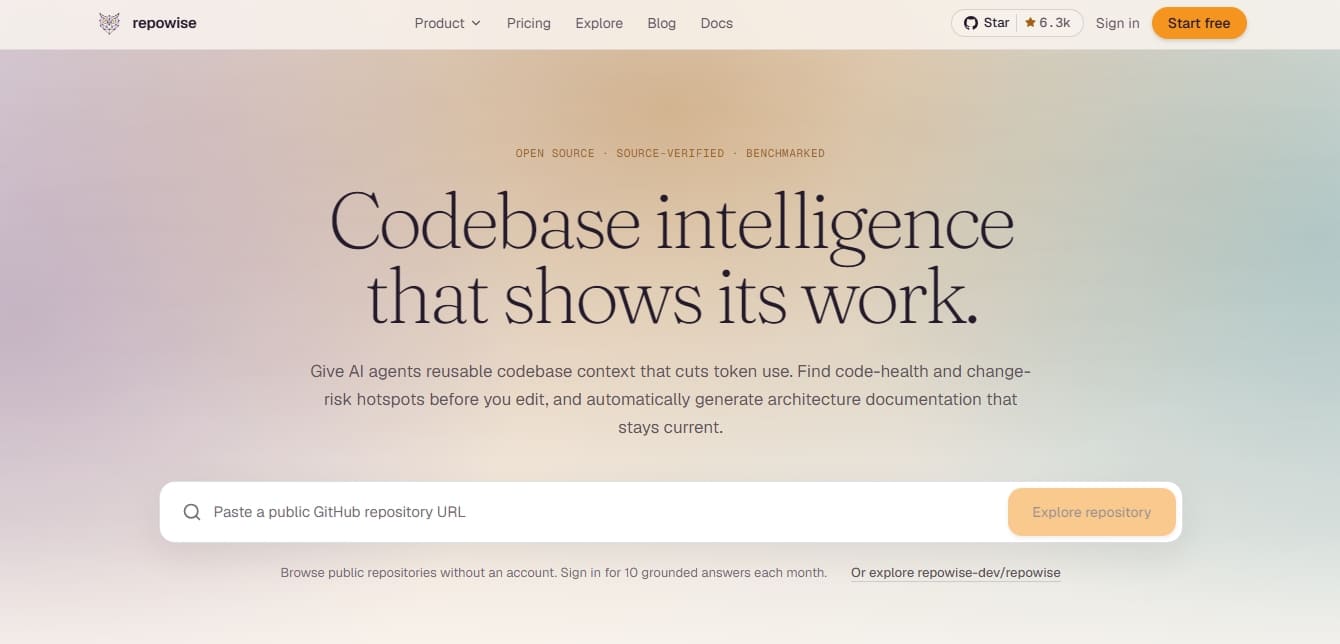
Provide code context to AI agents to save tokens. Analyze risks, assess software health, and generate always up-to-date architecture documentation.
General Information about Repowise
Repowise is a codebase intelligence platform designed to provide deep, reusable context for both developers and AI agents. Its primary function is to transform complex repositories into structured models that simplify software comprehension, risk detection, and language model workflow optimization. By centralizing code structure, Git history, and engineering decisions, the tool enables more efficient interaction with the development ecosystem from a desktop or integrated environments.
The operation of Repowise is powered by an advanced indexing engine that connects source code architecture with health signals, unit tests, and dependencies. Unlike other approaches that treat code as plain text, this tool utilizes the Model Context Protocol (MCP) and a command-line interface (CLI) to provide precise technical information to AI agents. This technology enables a significant token reduction (estimated at 31.6% in agent workflows) by preventing the AI from having to rediscover the project structure with every query.
Key capabilities include:
Change Risk Analysis: Predict the "blast radius" before editing critical files, identifying external dependencies and potential gaps in co-change testing.
Code Health Monitoring: Classify the risk of defects and maintainability issues through a scoring system validated against the repository’s actual bug history.
Automated Technical Documentation: Generate an architectural auto-wiki linked directly to the source code, which automatically identifies when documentation becomes stale following module changes.
Workflow Integration: Includes a GitHub Pull Request bot that reviews code diffs against the dependency graph and the team’s change history.
Repowise is an open-source (AGPL-3.0) solution ideal for engineering teams looking to improve the accuracy of their generative AI tools and reduce technical debt. By offering evidence-based insights rather than opinions, it is highly effective for conducting architecture reviews and streamlining developer onboarding for large-scale projects. The tool can be run locally for full data control or used via its managed version, maintaining compatibility with the market's leading language model providers.
Features and Use Cases of Repowise
How Repowise Works
Frequently Asked Questions about Repowise
What are the main features Repowise offers for analyzing my code?
Repowise analyzes code structure, dependencies, Git history, and repository health to generate technical documentation and provide precise context for AI agents.
Can I use Repowise for free?
Yes, the free plan allows you to index public repositories up to 250 megabytes and includes semantic search, dead code detection, and ten AI responses per month.
Does Repowise use my source code to train language models?
No, the tool never uses user code for model training and deletes temporary files from the working tree once the indexing process is complete.
Can I run the Repowise engine locally on my own machine?
Yes, the core of the tool is open source under the AGPL-3.0 license and can be installed locally to maintain full control over the execution environment and the model provider.
How does the credit system work in Repowise's paid plans?
Credits are consumed when generating automated documentation or asking questions about the code, while features like the symbol explorer and dependency graph are available at no additional cost.
Does Repowise support private repositories?
Private repository access is available starting with the Pro plan via the GitHub App, which ensures that all access tokens are properly encrypted.
How is Repowise different from a standard AI coding agent?
Repowise does not replace your agent or IDE; instead, it acts as an intelligence layer that provides them with a pre-processed code model to save tokens and improve response accuracy.
What does the Repowise Teams plan offer for organizations?
This plan allows you to share indexed repositories among multiple members, provides a health dashboard for your entire project portfolio, and includes authorship analysis and risk factor tools.
Repowise Pricing
Open Source (Self-hosted)
Free (AGPL-3.0 License).
Local code indexing.
Connect tools via MCP (Model Context Protocol).
Full control over the runtime environment and model provider.
Includes deterministic engine and MCP server.
Free (Hosted)
$0 per month.
Index up to 2 public repositories (max 250 MB per repo).
10 AI responses per month limit (grounded queries).
Analysis limited to the last 500 commits.
Semantic search and symbol explorer.
Hotspot detection and dead code analysis.
Dependency graph with 5 visualization modes.
Weekly index updates (requires README badge).
1 concurrent indexing job.
Pro
$15 per month.
Index up to 5 repositories (public or private via GitHub App).
Up to 5 GB size limit per repository.
Unlimited chat-with-code and quick responses.
Automated AI documentation generation.
$5 per month in included LLM credits (rollover).
Full commit history, no restrictions.
Automatic sync triggered by "push."
Bring Your Own Key (BYOK) for Anthropic, OpenAI, or Gemini.
Dependency scanning with vulnerability (CVE) and secret detection.
Teams
$60 per month (includes 3 users; $20 per additional user).
Includes all Pro features for the entire team.
Up to 25 shared repositories in a common pool.
Pooled AI credits ($5 per user per month).
Team-wide Pull Request (PR) review bot.
Portfolio health dashboard and engineering metrics.
Jira and Confluence integration.
Admin roles (owner, admin, member).
Up to 6 concurrent indexing jobs.
$100 daily LLM spending limit.
Enterprise
Custom pricing (contact us via the official website).
Unlimited repositories and indexing.
Customer-managed deployment (private cloud or on-premise).
Priority support with Service Level Agreements (SLAs).
SSO authentication (SAML/OIDC) and SCIM provisioning (in development).
Advanced Role-Based Access Control (RBAC) and multi-tenancy.
IP indemnification.
Dedicated account manager.
Repowise Screenshots